
“The foundational things are critical — it’s like cleaning up house a little bit after and bringing in some more nutrition to help rebuild and recover.” – Dr. Michelle Niesley
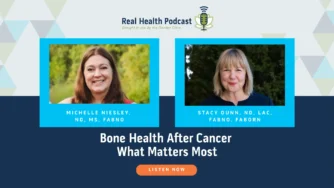
Dr. Michelle Niesley and nutrition specialist Jen Nolan discuss evidence-based strategies for recovery after cancer treatment, including nutrition, hydration, intermittent fasting, exercise, stress management, and affordable healthy eating.
Links and Resources
👉 Learn more about Jen Nolan and Remission Nutrition: https://www.remissionnutrition.com/
👉 Learn more about Dr. Michelle Niesley:
https://riordanclinic.org/staff/michelle-niesley-nd-ms-fabno/
👉 Learn more about becoming a co-learner at Riordan Clinic:
https://riordanclinic.org/become-a-patient/
Learn more about Riordan Clinic: https://riordanclinic.org
Explore integrative health services: https://riordanclinic.org/services/
Listen/Watch more Real Health Podcast episodes: https://realhealthpodcast.org
Disclaimer: The information contained on the Real Health Podcast and the resources mentioned are for educational purposes only. They’re not intended as and shall not be understood or construed as medical or health advice. The information contained on this podcast is not a substitute for medical or health advice from a professional who is aware of the facts and circumstances of your individual situation. Information provided by hosts and guests on the Real Health Podcast or the use of any products or services mentioned does not create a practitioner-patient relationship between you and any persons affiliated with this podcast.
Read the Transcript
VIEW FULL TRANSCRIPT
Narrator: 00:00
The information contained on the Real Health podcast and the resources mentioned are for educational purposes only. They are not intended as and shall not be understood or construed as medical or health advice. The information contained on this podcast is not a substitute for medical or health advice from a professional who is aware of the facts and circumstances of your individual situation. Information provided by hosts and guests on the Real Health Podcast or the use of any products or services mentioned does not create a practitioner patient relationship between you and any persons affiliated with this podcast. This is the Real Health Podcast brought to you by Reardon Clinic. Our mission is to bring you the latest information and top experts in functional and integrative medicine to help you make informed decisions on your path to real health.
Dr. Michelle Niesley: 00:56
Hi and welcome to the Real. Welcome to the Real health podcast. I’m Dr. Michelle Niesley and I’m here today with Jen Nolan, who is the head of Remission Nutrition and also nutritional advisor to the Reardon Clinic. So today we are going to be discussing nutrition. It’s very different when patients are undergoing cancer treatment. They’re having side effects from chemotherapy, radiation therapy, possibly recovering from surgery. Some of the nutrition recommendations are a little bit different during active treatment. We want to bridge that gap after treatment is over. So first, welcome, Jen.
Jen Nolan: 01:31
Thank you.
Dr. Michelle Niesley: 01:32
Good to be here. It’s wonderful to have you. I’m wondering if you can talk just in high level terms a little bit about the difference between active treatment nutrition recommendations and how they differ with post treatment.
Jen Nolan: 01:45
Yeah, I think sometimes they can be similar. And I also think that oftentimes when we’re in an active treatment, we’re using some of these more nutrition therapies. So we’re using some various types of, say, diets. I don’t love that term, but diets that are more therapeutic, so they might be a little bit more intense, maybe. I don’t want to say restrictive, but we might have more guidelines around these therapeutic nutritional programs, whatever that means. Sure. For that person. Right. And then we would go into, once we’re kind of post treatment, we might look at that a little bit differently where we’re like, all right, you’re doing great, you’re maybe in remission. All the things we can be a little bit more broad with our nutrition. Great. Does that help?
Dr. Michelle Niesley: 02:31
Yes, it does. And as we talk about, you know, overcoming those side effects, you really are in that, rebuilding, detoxifying and then looking forward to what’s next.
Narrator: 02:42
Yeah.
Jen Nolan: 02:42
And I think you just bring up a good point about side effects. Right. When somebody’s in their active treatment, they might have a harder time eating certain, a certain way.
Dr. Michelle Niesley: 02:51
Sure.
Jen Nolan: 02:52
So we’re much more in tune with the way they’re feeling, what they can even stomach and look at and smell like that.
Dr. Michelle Niesley: 03:00
So yes, and with taste changes those things start to get better and they eat foods that they didn’t maybe tolerate before now they can tolerate. And so then we shift into how we can use diet to potentially prevent recurrence. And I think one of the things we were discussing before we came on air, you know, we get a lot of co learners coming to us asking for really high level interventions. So they come, and I’m sure they come to you as well with that bag of supplements or asking about certain testing, which all of which is very important. But really the foundation of both nutrition and we’re going to touch on exercise as well. But just the foundation of what we can do on a daily basis makes such a big difference.
Jen Nolan: 03:42
Absolutely. The foundation is key. And I think too it’s like what you said, we’re in recovery mode. So now we might be able to taste things a little bit differently, smell them a little bit differently and our digestion might be coming back on again. Right. And so, yeah, the foundational things are critical and sometimes it’s like, I think about it as like cleaning up house a little bit after and bringing in some more nutrition to sort of help again rebuild and recover from here.
Dr. Michelle Niesley: 04:11
Yes, absolutely. And so I’m wondering if you can talk a little bit about, you know, you hear different myths. You know, one of them, for example, is sugar that feeds cancer. And not necessarily that’s a myth. But when I’m working with patients, I often will talk about, you know, foods that are high in sugar, obviously lower in nutritional value. So I’m wondering if you can talk a little bit about how you navigate some of the, what are maybe one or two of the things you hear patients coming in most commonly, be it a ketogenic diet versus vegan or you know, maybe a couple of the main questions that you end up hearing as we’re headed into survivorship and how you approach those questions.
Jen Nolan: 04:51
Yeah, I mean, I definitely meet every single person where they are and I think that’s so important. So I don’t want to ever say, oh, that’s not right or don’t do that or be really sort of strict and intense with them.
Dr. Michelle Niesley: 05:05
Harsh.
Jen Nolan: 05:07
But I definitely have a lot of people come to me and you know, especially when they come post, you know, in that sort of survivorship time period or afterwards, it’s a little bit of a different conversation. I feel like the more it’s like this fear piece that’s there and they’re like, I need to do every single thing absolutely perfectly. Or we’ve got the other side, the coin where it’s like, oh, I don’t have to worry about this. I’m all good.
Dr. Michelle Niesley: 05:33
Right.
Jen Nolan: 05:34
So if they’re coming to us, there’s. That’s usually not right.
Dr. Michelle Niesley: 05:36
Correct.
Jen Nolan: 05:37
Right. They’re looking for some guidance. And sometimes it’s like, does it have to be so strict? Absolutely know this or absolutely know that. So I bring people into this. Like, look, let’s talk about recovery. Like you just ran a marathon. And we need to recover the body. So let’s get adequate protein in. Let’s, you know, we look at labs too. So we’re looking at every single person when they come in. And some people are like on a wicked blood sugar roller coaster. So it’s still important that we’re like, okay, maybe let’s take it easy. Don’t start eating donuts and things. Right. Let’s eat quality, real food. I think that’s where I always land.
Dr. Michelle Niesley: 06:20
Yeah.
Jen Nolan: 06:21
Juicing is another one that can come up. That’s a common one. Vegan. I’m really careful when people are really strict. Plant only because I’m worried about getting enough protein to recover.
Dr. Michelle Niesley: 06:35
What are some of your favorite vegan protein tips and tricks?
Jen Nolan: 06:40
That’s a tricky one.
Dr. Michelle Niesley: 06:42
Yeah.
Jen Nolan: 06:42
I’m like, well, maybe you would be willing. This is not going to be the answer you’re looking for, but would you be willing to have some eggs? Would you be willing to have some high quality fish? That’s what I start with. If somebody is like, absolutely not, then we really get, you know, we get crazy with it and we’re like, okay, hemp can be helpful. I really like hemp as a plant protein source. Some mushrooms are amazing because they’ve got a really good protein profile and all the other beautiful things.
Dr. Michelle Niesley: 07:11
Right.
Jen Nolan: 07:12
But it’s tricky. Yeah. You know, there’s some legumes that we can use, but we have to, you know, make sure it’s not just opening up a can of beans.
Dr. Michelle Niesley: 07:21
Right.
Jen Nolan: 07:21
It’s really like cooking it in a really traditional way, all of that. So, yeah, it’s tricky for some people. I had a client just the other day. She’s very vegetarian based. She lives in another country and she told me that she is using bone broth and I was like, really? Because she’s not eating any other food. And it’s something about the texture.
Dr. Michelle Niesley: 07:42
Yeah.
Jen Nolan: 07:43
For her. So.
Dr. Michelle Niesley: 07:44
Yeah, yeah.
Jen Nolan: 07:45
So anyway, it’s bending.
Dr. Michelle Niesley: 07:47
Yeah.
Jen Nolan: 07:47
With people.
Dr. Michelle Niesley: 07:48
Yeah, absolutely. How are you? You know, a lot of the research in. When we’re looking at it. From a survivorship or thrivership perspective, you know, we talk to our co learners about the importance, again, of good food, of movement and exercise, and really a lot of the information around nutrition. There’s some awareness amongst conventional oncologists about the need for appropriate food and whole foods. Obviously, usually they end up referring to people to kind of work with people on menus a little bit. But I’m wondering if you can talk about your experience or knowledge, a little bit of some of that scientific literature and why, you know, if you do have that person who’s like, I’ve been through chemo, we’re getting scans every three months. What I eat doesn’t matter. I’m wondering if you can kind of talk to me about that conversation and push them in the direction of understanding why nutrition is so important.
Jen Nolan: 08:44
I mean, I believe so strongly that food, what we eat, matters. And, you know, that’s my. Like, I could stand on this table right now and talk about that and shout it out.
Dr. Michelle Niesley: 08:54
Yes.
Jen Nolan: 08:55
So I just. I can’t believe that it doesn’t. Because when we’re eating real food, we are getting it. Just one example, we’re getting, say, vegetables, and we’re getting fiber from the vegetables and we’re feeding our gut.
Dr. Michelle Niesley: 09:08
Yeah.
Jen Nolan: 09:09
We know how much of our gut contains our immune system.
Dr. Michelle Niesley: 09:13
Right.
Jen Nolan: 09:13
We know that if our immune system isn’t there, we’re at higher risk for all kinds of things. So why wouldn’t it matter? So when we’re, you know, I just can’t. I can’t buy it. I can’t buy that statement. And I just know that. I know that nutrition is so vastly important for all of us and eating real food.
Dr. Michelle Niesley: 09:34
Yeah.
Jen Nolan: 09:35
So I don’t know. I just can’t. Nutrition just matters.
Dr. Michelle Niesley: 09:39
It matters. It does.
Jen Nolan: 09:40
Me being really passionate and like, that’s why I do this work with people.
Dr. Michelle Niesley: 09:44
Yeah.
Jen Nolan: 09:45
It matters.
Dr. Michelle Niesley: 09:45
And it is those foundational building blocks. And I think that cognitively, all of us know, I need to eat a good diet. Right. But I think when you actually break it down, those healthy foods contain healthy fats, proteins, vitamins, minerals. I did a podcast recently with Dr. Drew Rose where we are speaking about mental health and the importance of appropriate protein for those neurotransmitters and how most biochemical reactions require, let’s say, to make more serotonin, you need B6 and magnesium to make that reaction go. And so getting a diet that is high in healthy nutrients is actually going to help your body run like a better oiled machine. Right?
Jen Nolan: 10:23
Well, yeah. And I think that statement, that simple statement we hear like, you are what you eat.
Dr. Michelle Niesley: 10:27
Yes.
Jen Nolan: 10:28
So, yeah. You know, I don’t know that we want to be a candy bar.
Dr. Michelle Niesley: 10:32
Right.
Jen Nolan: 10:32
I don’t know.
Dr. Michelle Niesley: 10:33
Right.
Jen Nolan: 10:33
Really makes sense. But I just feel like our cells, like you think about our cell structure. Yeah. And if our cell is that. That fat bilayer of the cells, like we think about inflammation, if we’re eating a diet that is all just chock full of inflammatory ingredients, lot of junky food is, or not real food is, then we’re walking around, we’re inflamed, we don’t feel good, we ache, we can’t move our bodies, we don’t sleep very well. You know, we know that cancer cells love inflammation.
Dr. Michelle Niesley: 11:11
Yes.
Jen Nolan: 11:11
They love to be inflammatory.
Dr. Michelle Niesley: 11:13
Yeah. Because it definitely suppresses the immune system. It creates an environment where there’s more confusion and our body doesn’t necessarily know what to pay attention to. And I actually want to pick up on something that you just said. She. So Jen mentioned a lipid bilayer. And so every single cell in our body is made up of a double layer of little fatty globules. And depending on the kind of fats that are in your diet, that membrane to let nutrients in and waste products out of your cell can either be really pliable if you’re getting good omega 3 fatty acids. Right. Or if you’re eating a lot of saturated fat and fried foods and fast food and other things that are not as healthy, that membrane can become more rigid. So again, more challenging to get nutrients in and waste products out. So literally what we eat impacts us at the cellular level.
Jen Nolan: 11:58
Absolutely.
Dr. Michelle Niesley: 11:59
And I think that a lot of people think of it for body composition. Or I want to lose those 5 or 10 pounds or calories. Calories, exactly. But we don’t necessarily think about food impacting us literally down to the cell.
Jen Nolan: 12:10
Yeah. And I think that there’s also so many, I think about food like that food as medicine concepts. So if we’re eating these things, like think about that rainbow of nutrients or of fruits and vegetables, we’re eating this rainbow and then we’re getting all these incredible phytonutrients and all these things for our bodies to use to keep us from getting sick. Right. To again, keep our inflammation down. To help our skin, to help our nails, help our hair, all of the things. So we reach, and this is back to the foundation. Oftentimes we’re reaching for these supplements and all of these crazy cleanses and detoxes and diets. And it really can be quite simple. I think we complicate it. Yeah. And we make it expensive.
Dr. Michelle Niesley: 12:53
Yes.
Jen Nolan: 12:54
And it doesn’t have to be perfect. But I also think that if the majority of our food is real whole food, we’re in a much better position to be healthy.
Dr. Michelle Niesley: 13:05
Yes.
Jen Nolan: 13:05
And to heal.
Dr. Michelle Niesley: 13:06
Agreed. And I know when I’m working with patients that are just coming off of chemotherapy, if their last day of chemo is today, I’m not like, let’s get you in a detox tomorrow. I give them at least 30 days to eat whole healthy foods, build your body up and repair. Because again, some of those higher level interventions are so much more successful when you have a really strong foundation. You bet.
Jen Nolan: 13:27
I mean, the amount of people I always think about, water hydration, when I think about foundation and the amount of people that come, we always ask, how much water do you drink? And it’s astounding to me how many people are not drinking enough water. Like half of your body weight in ounces of good filtered water a day. If you’re exercising, sweating, you’re in a really hot, humid place.
Dr. Michelle Niesley: 13:49
More.
Jen Nolan: 13:49
Yeah. So.
Dr. Michelle Niesley: 13:50
So what are some tricks? So let’s kind of follow that water path. So if someone isn’t drinking very much water, obviously maybe substituting what they are if they’re drinking a diet soda, you know, can we substitute? But what are a couple tricks to try and get people to be better hydrated.
Jen Nolan: 14:05
Yeah. I think that always having a water bottle with you.
Dr. Michelle Niesley: 14:08
Yes.
Jen Nolan: 14:09
It is really important. I like to. Yeah, always. And I like to set myself up in the morning for my water. So I’m like, okay, I’m going to have two of these 32 ounce water bottles or whatever and then I’ll probably have some herbal tea. But I just try to do that in the morning, have it all ready and then it’s. It’s good. And then I know that I’ve had enough. And I don’t know about you, but I can always tell if I’ve not had enough water.
Dr. Michelle Niesley: 14:30
Absolutely.
Jen Nolan: 14:31
You know?
Dr. Michelle Niesley: 14:31
Yeah.
Jen Nolan: 14:32
So that’s huge. Herbal tea is wonderful. There’s also a lot of really nice things. Like hibiscus tea is one of my favorites, especially in the summer. It doesn’t have to be hot. Yeah. It’s high in vitamin C. It’s delicious and it’s pretty. So things like that, like maybe it’s a little bit of hibiscus tea in your water during the day. Yes, that’s nice too. So it changes the color, changes the flavor a little because it makes it interesting like water.
Dr. Michelle Niesley: 14:55
Yeah.
Jen Nolan: 14:55
And sometimes coming off of, you know, chemo or something like that, nothing tastes good.
Dr. Michelle Niesley: 14:59
Right.
Jen Nolan: 15:00
So how do we change the flavor a little bit?
Dr. Michelle Niesley: 15:02
Right, yeah, absolutely.
Jen Nolan: 15:04
That’s one of my tricks. It’s just to have it available.
Dr. Michelle Niesley: 15:07
Yeah, absolutely. And I know for my patients, when I’m working with them as well, one of the comments that I make is, sometimes if they’re hungry or they’re eating, but they can’t quite find the thing they want, sometimes it’s like, have a.
Jen Nolan: 15:18
Glass of water first.
Dr. Michelle Niesley: 15:19
Like you might actually need water as opposed to you thinking you need food, but maybe your brain is actually really telling you, yeah, you need more hydration.
Narrator: 15:31
Are you looking for a delicious way to boost your immune system? Meet sufficiency, the crave worthy immune support drink that makes staying healthy a treat, not a chore. Packed with 4000mg of non GMO vitamin C, sufficient C is more than just a drink. It’s a powerhouse of immune boosting goodness. With added L, lysine, bromelain and 96% pure caffeine free green tea extract. Every sip is a step towards better health. And the best part, it tastes amazing. Our lemon peach immune mix is sweetened with pure stevia, no sugar, no guilt. Plus it’s plant based, gluten free, kosher and completely caffeine free. So why settle for boring when you can have a flavorful immune boosting refreshment? Visit sufficiency.com and mix up your health routine with sufficiency because your health deserves a delicious boost.
Dr. Michelle Niesley: 16:29
So in talking about survivorship, I know that one. You know, there’s a study out there, for example, on intermittent fasting. So there was an intermittent fasting study several years ago in women with early stage breast cancer that found that if you fast for 13 hours or more overnight, it reduces the risk of recurrence by up to 36%, which is huge when you consider tamoxifen and aromatase inhibitors in general decrease the risk of recurrence by around 40%. Right. So I’m wondering if you can talk to me a little bit because I feel certain. I don’t want to say fads because I don’t believe intermittent fasting is a fad, but I want you to talk to us a little bit about intermittent fasting and the benefits potentially and how to. I think a lot of people think I can only eat for six hours a day or take little quizzes online and find, you know, what their fasting window should be. So I’m wondering if you can just talk to us a little bit about the benefits and then how if someone isn’t fasting right now, how they can start.
Jen Nolan: 17:28
Absolutely. I think it is bad when we’re talking about those things like online, like everybody needs to do this thing, take a quiz to figure it out, all those things that feel fad like to me. But just intermittent fasting I think is so rooted in science. And I believe, and this is my belief that all of us could benefit from fasting for 13, 12, 13, 14 hours every day. Yeah, that makes total sense to me. And that is this very ancestral way of eating if you think about it. I mean, maybe not even way back, that’s a little bit different. But like I always say, let’s go back to the olden days where we ate three square meals a day.
Dr. Michelle Niesley: 18:10
Yeah.
Jen Nolan: 18:10
We were eating kind of in the daylight.
Dr. Michelle Niesley: 18:12
Right, right.
Jen Nolan: 18:13
We were having gaps in between meals. Yes. Square meals were, they were balanced. It wasn’t just one thing or one nutrient. Yep. Right.
Dr. Michelle Niesley: 18:22
Yeah.
Jen Nolan: 18:22
So that’s where I land. That is about 12 to 13 hours a day. Right. Breakfast, lunch, dinner.
Dr. Michelle Niesley: 18:30
Yeah.
Jen Nolan: 18:30
An earlier dinner. There’s gobs of research around how beneficial that can be. Yes. So it doesn’t have to be, oh, I’m 16, eight or whatever people are saying around their intermittent fasting.
Dr. Michelle Niesley: 18:42
Right.
Jen Nolan: 18:42
It can be 13 hours. That’s a great rule of thumb. So to get things started, I mean one of my. I have a lot of clients that I talk to that are eating at night. You are not going to be able to get a very, a 13 hour fast very easily if you’re eating after dinner. So that’s where I start with a lot of people.
Dr. Michelle Niesley: 19:00
Okay, okay.
Jen Nolan: 19:00
So I’m like, okay, if you’re eating dinner at 7pm or you’re done with dinner at 7, you go to bed at 10 in that window, you are drinking maybe some herbal tea to get hydrated, things like that. Sure. Chilling out, not eating popcorn, watching tv. Right. Even though it’s delicious.
Dr. Michelle Niesley: 19:17
Right.
Jen Nolan: 19:18
So that’s a biggie. So when people are not snacking at night, after dinner.
Dr. Michelle Niesley: 19:23
Okay.
Jen Nolan: 19:24
They likely will sleep better.
Dr. Michelle Niesley: 19:27
Right.
Jen Nolan: 19:27
Have better blood sugar regulation, less inflammation, digestion’s better because the gut is having a chance to kind of do its thing.
Dr. Michelle Niesley: 19:35
Yeah. A chance to rest.
Jen Nolan: 19:36
Yes. And so that’s huge. Some people look at me like I am crazy. So then what do I do? I meet everybody where they are. Okay. I can’t sleep unless I’ve had some food. That might be a blood sugar regulation issue. So we’re going to look at that. If they absolutely insist, I have them have something that has more fat and protein in it. Right.
Dr. Michelle Niesley: 19:57
And why.
Jen Nolan: 19:59
Yes. So they don’t get as much of a blood sugar spike.
Dr. Michelle Niesley: 20:03
Correct.
Jen Nolan: 20:03
So they’re just eating popcorn and a lot of people are like, not putting fat in their popcorn because of course fat’s bad. So I’m lying. And yeah, they have that. So they’re getting all this carbohydrate and they get this big blood sugar rise.
Dr. Michelle Niesley: 20:15
Correct.
Jen Nolan: 20:15
Right, Yep. That’s not going to do anyone any favors for sleep. Right.
Dr. Michelle Niesley: 20:20
And then the crash is going to be harder too.
Jen Nolan: 20:22
Exactly. Yeah. Yeah. One and you’re going to wake up. Yep. So I think that is where I would start. It’s like trying not to. If you’re really struggling and try to have a ritual around it instead of that snack that you always have when you’re going to watch this program. What about you?
Dr. Michelle Niesley: 20:40
Your cup of tea? Yum.
Jen Nolan: 20:42
Yeah. It’s something to keep them busy. I actually had a woman the other day, she loves to knit. And I was like, that’s what you get to do instead of eating. Munching on the snack, you know that your partner next to you is munching on.
Dr. Michelle Niesley: 20:54
Sure.
Jen Nolan: 20:55
So that’s where I begin. And then I go into this, you know, how can we not eat maybe immediately when we wake up in the.
Dr. Michelle Niesley: 21:03
Morning, you know, so again, a cup of tea or.
Jen Nolan: 21:06
Yeah, yeah. And then gaps in between meals instead of grazing throughout the quote, unquote, quote eating window, which is that time, you know, you start your eating window in the morning and then you would end it at dinner. So not doing a ton of snacking. Now, I wanted to say this, that for some people where we’re working with nausea, poor appetite, we’re trying to rebuild and people do not have a lot of capacity. That’s going to be a totally different conversation. Of course, this is someone who is in that drivership. We’re building back up and we’re retraining blood sugar. It’s pretty awesome.
Dr. Michelle Niesley: 21:42
Well, and I think to take off what you just said, too, I think that doing away with the nighttime snack, that popcorn or the bowl of cereal, I think is. It is so incredibly Important. And also making sure people’s dinners contain adequate protein, healthy fat. That’s actually going to stabilize that blood sugar for a longer period of time as well. Compared to a bowl of pasta.
Jen Nolan: 22:01
Yeah.
Dr. Michelle Niesley: 22:02
Right.
Jen Nolan: 22:02
That’s it. And I’m often asked that question. Are you eating enough at your dinner meal? Is it balanced enough? Because if it’s a big bowl of pasta, red sauce and maybe there’s a salad, there’s no protein and there’s not a lot of fat and so you’re not going to be able to last very long.
Dr. Michelle Niesley: 22:20
Right.
Jen Nolan: 22:21
That’s where that balance comes in. You’ve got to get that protein and some fat in. Yeah. Olive oil, right?
Dr. Michelle Niesley: 22:26
Yeah.
Jen Nolan: 22:26
All over your salad. And maybe a couple of really yummy grass fed meatballs. Turkey meatballs, whatever side of fish.
Dr. Michelle Niesley: 22:34
Yes, very good.
Jen Nolan: 22:35
Maybe not with pasta and sauce. Yeah.
Dr. Michelle Niesley: 22:38
But who knows? I’m sure you can make it delicious. Very good. Okay. Is there anything else that you want to say about diet? I do want to ask you a couple questions about exercise and movement as well as we talk about the post active treatment patient. Any other tips or tricks or just parting thoughts about nutrition and survivorship?
Jen Nolan: 22:58
You know, I just think that remembering that you’re on a mission to sort of recover and rebuild.
Dr. Michelle Niesley: 23:05
Sure.
Jen Nolan: 23:05
So love on your tissues, love on your cells by e whole foods based diet. Keep your body hydrated. That’s so important. By drinking enough water. Those are so foundational. And you know, I could talk for hours and hours about it, but yeah, just eat high quality food as best you can.
Dr. Michelle Niesley: 23:26
Yeah. And it matters. And really, one last question, because this also does come up as far as nutrition is concerned, when we think of eating high quality foods or a whole foods diet, some people start to think about expenses.
Jen Nolan: 23:38
Yep.
Dr. Michelle Niesley: 23:38
And that it’s expensive to eat a healthy diet. So I’m wondering if you can address the expense argument.
Jen Nolan: 23:46
Well, it’s interesting because I hear that a lot and then I see somebody’s list full of supplements and I’m like, interesting if that’s something that you’re able to do. So what if we shifted a little bit and thought of this food first approach. How can I get those nutrients from my food? Rather than. I’m not saying supplements are bad because they have their time in place for sure. But look at that. And then, you know, I don’t want to be cynical, but I might also say, so is the doctor right? So if you can eat high quality food, that also doesn’t mean perfection. And I think that’s what a lot of people do. Oh, she just wants me to eat all organic and all fresh food, and that’s really expensive. So I always listen to everyone and I come up with ideas on, like, how can we shop differently, where can we order food from if it’s not local to you? And I’m always very mindful of the dollar as well. It’s. And it is expensive. Right. There’s a way to do it. There’s the EWG.org they put out that the, you know, the clean 15 and the dirty Dozen. And that can. Can help us understand what foods are more important, maybe to buy organic if you can. Yeah. Like, apples are often on that list. Strawberries are on that list. And then there are some healthy foods that are not on that list. Right. They’re the clean 15y. So they might not be as important. So that’s how you can kind of do it. Yeah, a little bit. You know, I know I’m not sure about it. I mean, I know we’re talking to a lot of people and a lot of places. I try to go to farmers markets.
Dr. Michelle Niesley: 25:11
Sure.
Jen Nolan: 25:12
And depending on where you are, that can be quite expensive, but sometimes it’s less.
Dr. Michelle Niesley: 25:16
Yeah.
Jen Nolan: 25:17
So it just depends on what. Where you are, what your. Your location is and what those farmers are growing. Sure. So. And I think that’s a great thing to support anyway.
Dr. Michelle Niesley: 25:26
Yeah.
Jen Nolan: 25:26
And it’s social.
Dr. Michelle Niesley: 25:27
Buying local, fresher food, higher nutritional value, not picked as early to get to market and everything, so.
Jen Nolan: 25:33
Yeah.
Dr. Michelle Niesley: 25:33
Yeah. Good. Excellent. Okay, exercise. Let’s move on to movement, because as we are trying to eat better out of treatment, we are also usually starting if we haven’t been moving because of side effects or joint pain or neuropathy, numbness and tingling during active treatment. Now we’re starting to bridge that gap again and starting to move a little bit more. So you know, mentioned sleep. We can do a whole show on sleep as well. But I’m wondering if you can talk about the importance of exercise. And when I say exercise, I know a lot of patients with me think an hour in the gym, sweaty, lifting a ton of weights and being exhausted, and how with the state that they’re in currently, there’s no way they can exercise because their expectation is to go from here to here. Right. So obviously we need to do some education around that. But I’m wondering if you can talk a little bit about the importance of starting to exercise, or if you’re already exercising, you’re going to your 10,000 steps a day or something in the importance of increasing that to things like, you know, weight bearing, exercise and whatnot as we move past active treatment.
Jen Nolan: 26:42
Yeah, that’s. It’s so important. And I think what you said about, like, it’s not just from here to here, like you don’t want to push. You know, if we push really hard, then we’re creating a lot of stress in the system and then the system isn’t able to do all that recovery that we need it to do.
Dr. Michelle Niesley: 26:59
Right. And you’re increasing inflammation like we’re talking about. Right? Yeah.
Jen Nolan: 27:03
And so I think it’s really important to say, you know, with muscle especially, like a lot of times people are going through treatment and they’re, they might lose weight, they’re losing muscle mass. Correct. And so it’s that whole if you don’t use it, you lose it. So while someone’s on that journey, if I have the opportunity to be working with them, we’re talking about what are some really simple things that you can do during, while you’re seeing like, oh my gosh, my legs, my tush, you know, things are like shrinking.
Dr. Michelle Niesley: 27:29
Yeah.
Jen Nolan: 27:29
So there is that factor. So after it’s rebuilt and if you don’t use it, you lose it. You have got to move and again gently. Yeah. So depending on where someone’s at, like sometimes I’ll have people do push ups on a countertop or the wall.
Dr. Michelle Niesley: 27:47
Or the wall.
Jen Nolan: 27:48
And then I think about larger muscle groups. So I’ll think about the quads and the hamstrings. And if you can get it, I’m like, do you have a couple of steps in your home that are safe, where you have a railing? Start going up and down, alternating legs, using that. So y is really important for getting that muscle mass back. Why do we need muscle mass? Muscles are a glucose sponge.
Dr. Michelle Niesley: 28:13
Right.
Jen Nolan: 28:13
So they are going to help us regulate blood sugar. It’s critical. Yeah, right. They also happen to make the bones stronger. So how many times are we hearing about people with bone mass? Right, right. Or bone strength.
Dr. Michelle Niesley: 28:26
Right.
Jen Nolan: 28:27
And a lot of these therapies are.
Dr. Michelle Niesley: 28:29
Just hammering the bone, the steroids and everything else.
Jen Nolan: 28:31
Right. Yeah. And so remember that when you flex a muscle, you have these points that put strain on that bone. So by flexing that muscle, you’re helping your bone because of your bone structure in the inside, it’s like fighting back that scaffolding when it’s being strained.
Dr. Michelle Niesley: 28:49
Right.
Jen Nolan: 28:49
That is how to keep bone mass. People are getting injections, they’re taking gobs of Maybe supplements or medications to keep their bones going and they’re not moving.
Dr. Michelle Niesley: 29:00
Right.
Jen Nolan: 29:00
And so that’s just one example of what we need to do to kind of recover.
Dr. Michelle Niesley: 29:06
Yeah. And some of the studies, I like the discussion about if we are capturing people during active treatment, how if you are able to do just those little bits of exercise, and could it be as easy as having a chair that’s nice and stable and standing up and then kind of sitting back down or hovering your butt over that chair and then standing back up again, or arm weight, something seated if the feet are feeling a little bit unstable, how you can just stay even moderately active, mildly active. A lot of the studies during active treatment actually show reduction in fatigue, reduction infection rates, better sleep, less pain. And so a lot of the side effects are actually significantly better if you’re able to stay active during active treatment. And then parlaying that obviously into survivorship, there’s actually studies showing that the survivor, like the survival rate. Right. So the risk of recurrence or the risk of death from a certain diagnosis is actually decreased based on exercise. And we all have to eat every day and we all ideally have to move. Do you have any favorite X, Y? I really wanted to kind of veer also, not only from active exercise, but also I know that you spoke, had a podcast with Dr. West talking about stress in the immune system and the importance really of stress. And so I’m wondering if you can. So we’ve talked food, we’ve touched on exercise, but then that stress reduction, that comes along with it, because a lot of people who are coming out of treatment are trying to eat better and they’re trying to exercise, and maybe they’re getting back to work. And now the family thinks like, oh, you’re done with treatment. You’re fine. They don’t feel fine. And so that stress is a different stress than it was when they were actively getting chemotherapy, but that stress is really high. So, again, this could be an entirely different podcast as well. But I’m wondering if you can just say a couple words about stress management as we’re moving from that active treatment space to the. To what’s next.
Jen Nolan: 31:07
Yeah, and that’s. You’re right. Could be a whole big conversation. And I think that too, remembering that the food we choose and the exercise we choose can also help us lower that stress response in the body. Sure. We are likely not going to be able to manage our stress. Our stress is always going to be there. It’s what. It’s how we’re reacting to that stress.
Dr. Michelle Niesley: 31:29
Yes.
Jen Nolan: 31:29
And so there’s a lot of things we talk about with nervous system kind of regulation every day with our clients. And it’s so important. And if they are, say, exercising, moving their body, circulating their blood, their lymph, all those things, they might sleep better. Better.
Dr. Michelle Niesley: 31:46
Yeah.
Jen Nolan: 31:47
If you’re sleeping better, you’re going to be hopefully less stressed because you can deal with the things better. Right. When you’ve had a good night of sleep, you know, the stress around. Oh, great. Now I have to cook a meal for myself and for my family. Like, that’s a big conversation and everybody thinks I’m fine now because I’m done.
Dr. Michelle Niesley: 32:08
Right.
Jen Nolan: 32:08
And, you know, we really have to help with a lot of the tips and tricks around that too, like how to not make everything so hard and so complicated and how to ask for help.
Dr. Michelle Niesley: 32:19
Yes.
Jen Nolan: 32:19
And accept help. That’s even more important.
Dr. Michelle Niesley: 32:22
Right.
Jen Nolan: 32:23
Because there’s a lot of people willing.
Dr. Michelle Niesley: 32:24
Yeah.
Jen Nolan: 32:25
So, yeah, the stress component is really important. And I think, you know, I’m always like, how can we, like, take some breaths? How can we do a little bit of even movement, like going for a walk outside? How quickly your nervous system can just be more calm. Yes. Right. It can be five minutes.
Dr. Michelle Niesley: 32:42
Yeah.
Jen Nolan: 32:43
It can be sitting out in the sunshine.
Dr. Michelle Niesley: 32:44
Yeah. That’s important. And I love, as we’re starting to wrap up some of our themes, but I love what we’re talking about again is coming back to that word, foundational. So if someone is high stress, they may not be sleeping all that well. And if you’re not sleeping that well, making the right dietary choices becomes more challenging because we reach for that sugar or that caffeine or just the thing stress and the things that just make our comfort foods or something. Right. And then if we’re eating in a way that maybe isn’t as helpful, we’re probably not as motivated to exercise. And so it really, I think the thing that we try to make sure that co owners are aware of is how connected all of these things are.
Jen Nolan: 33:23
Massive. And I think, remember that when we reach for that quick thing, that’s going to give us that quick thing that boost, that little bolt or jolt or high that is not going to last for. In the.
Dr. Michelle Niesley: 33:36
Right.
Jen Nolan: 33:37
So exercise will.
Dr. Michelle Niesley: 33:38
Yes.
Jen Nolan: 33:39
Right. Going for a walk outside will. Yes. Eating a balanced meal will.
Dr. Michelle Niesley: 33:43
Right.
Jen Nolan: 33:44
That quick fix from that soda or that candy or whatever, it’s going to go up and you’re going to feel better and then you’re going to go right back down again. So I think that’s really important. And again, it’s not about perfection. It’s about doing the best you can, being really holistic. And you’re right, it all matters. It’s all connected.
Dr. Michelle Niesley: 34:02
Well, with that, I’d like to leave it there. So thank you so much for your time. I’m so glad you could join us today.
Jen Nolan: 34:07
Thanks Michelle.
Dr. Michelle Niesley: 34:08
Thank you.
Narrator: 34:11
Thank you for listening to the Real Health podcast. If you enjoy this episode, be sure to subscribe and leave us a review. You can also find all of the episodes and show notes over@realhealthpodcast.org also be sure to visit reardonclinic.org where you will find hundreds of videos and articles to help you create your own version of Real Health.