
“Medicine is not just about treating disease — it’s about helping people discover health.” —Dr. Drew Rose
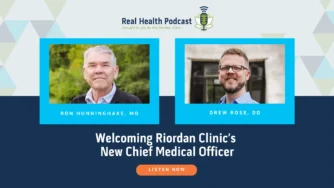
In this episode of the Real Health Podcast, Ron Hunninghake, MD, welcomes Drew Rose, DO, Riordan Clinic’s new Clinical Medical Director. A Wichita native, Dr. Drew brings deep training in internal and osteopathic medicine, years of experience as a hospitalist, and a passion for integrative, patient-centered care. He shares his personal journey from early health challenges, to global rotations in Kenya, to the frontlines of COVID care, and why he chose to return home to Wichita and join Riordan Clinic.
You’ll hear:
→ How Dr. Drew’s own health experiences shaped his pursuit of medicine
→ Why osteopathic principles align so closely with Riordan Clinic’s mission
→ Lessons from practicing global medicine in Chicago and rural Kenya
→ What serving in the ICU during COVID taught him about the challenges of one-size-fits-all care
→ How he hopes to serve patients and the Wichita community in his new role
About Drew Rose, DO
Drew Rose, DO, is Riordan Clinic’s Clinical Medical Director. A Wichita native, he is board-certified in internal medicine with advanced training in osteopathic principles and practices. He brings years of experience as a hospitalist and in global health, along with a strong commitment to supporting patients in their health beyond disease management.
Learn more about Dr. Drew or schedule a new patient appointment: https://riordanclinic.org/doctors/drew-rose/
Links
🎟️ Register for the Cancer Care Reimagined Conference: https://cancercarereimagined.org
🌍 Explore the Riordan Clinic: https://riordanclinic.org
🎧 Listen to more episodes of the Real Health Podcast: https://realhealthpodcast.org
Disclaimer: The information contained on the Real Health Podcast and the resources mentioned are for educational purposes only. They’re not intended as and shall not be understood or construed as medical or health advice. The information contained on this podcast is not a substitute for medical or health advice from a professional who is aware of the facts and circumstances of your individual situation. Information provided by hosts and guests on the Real Health Podcast or the use of any products or services mentioned does not create a practitioner-patient relationship between you and any persons affiliated with this podcast.
Read the Transcript
VIEW FULL TRANSCRIPT
Riordan Clinic [00:00:00]:
The information contained on the Real Health Podcast and the resources mentioned are for educational purposes only. They are not intended as and shall not be understood or construed as medical or health advice. The information contained on this podcast is not a substitute for medical or health advice from a professional who is aware of the facts and circumstances of your individual situation. Information provided by hosts and guests on the Real Health Podcast or the use of any products or services mentioned does not create a practitioner-patient relationship between you and any persons affiliated with this podcast. This is the Real Health Podcast brought to you by Riordan Clinic. Our mission is to bring you the latest information and top experts in functional and integrative medicine to help you make informed decisions on your path to Real Health.
Ron Hunninghake, MD [00:00:56]:
Well, hello, everyone. I’m Dr. Ron Hunninghake. This is the Real Health Podcast. It’s my pleasure today to introduce Dr. Drew Rose. He’s our new doctor here at the Riordan Clinic.
Drew Rose, DO [00:01:07]:
Hello. Thank you.
Ron Hunninghake, MD [00:01:07]:
Dr. Drew, is that okay if we.
Drew Rose, DO [00:01:09]:
Dr. Drew’s perfect. Yes.
Ron Hunninghake, MD [00:01:10]:
Okay. You’re a. You’re a Wichita guy, right?
Drew Rose, DO [00:01:14]:
I’m born and raised Wichita, yes.
Ron Hunninghake, MD [00:01:16]:
Okay. Well, since I know that we went through a whole process, but I thought it might be good to kind of share with the audience how, how did we come in contact with you? Because it’s, we’re, we’re very thrilled and I’ll, I’ll get into that in more detail, but how did you first hear about us?
Drew Rose, DO [00:01:34]:
So my dad actually interviewed several years ago, I want to say about five, six years ago, for a marketing position. Wasn’t really a good fit. It wasn’t really his background either, but that’s how my name kind of came up, I guess, in the interview. At one point in time I was in residency and, and it was something that stuck with the recruiter at the time, Vicky, and that I’m an osteopath and that I did a fellowship in medical school that really focused on the principles of osteopathy. And it seemed to be in line with what Riordan was looking for at the time.
Ron Hunninghake, MD [00:02:07]:
Tell the audience, what are those principles? This is fascinating.
Drew Rose, DO [00:02:11]:
Osteopathy, just a little background founded by a Kansas guy, Doctor A.T. Still, and he actually thought there was a better way, at least trying to really look at the human body and the self regulation capabilities and came up with the four tenets of osteopathy where the person is a unit of body, mind and spirit.
Ron Hunninghake, MD [00:02:34]:
Wow.
Drew Rose, DO [00:02:35]:
The body is capable of self regulation and self healing and that structure and function are interrelated. And then the fourth tenet is kind of just there as appropriate treatment is. Based off the above tenets.
Ron Hunninghake, MD [00:02:47]:
Yes.
Drew Rose, DO [00:02:48]:
So that’s really what osteopathy the core is.
Ron Hunninghake, MD [00:02:52]:
He and Dr. Riordan could have been drinking buddies. That’s right in line with the way Dr. Riordan felt in terms of this. It was called the center for the Improvement of Human Functioning when he first started. What drew you drew into that? Was there a life experience or how did that go?
Drew Rose, DO [00:03:16]:
Yeah, there was times when I was younger, I had some health issues. I had Epstein-Barr virus, very to a point where I actually missed half of seventh grade.
Ron Hunninghake, MD [00:03:27]:
Wow.
Drew Rose, DO [00:03:28]:
Went through some testing and just kind of felt like you’re on a merry go round of doctor visits. And I was out of school, so I wasn’t around my friends and all these different things. And it kind of got me exposed to being the patient, especially early in life and not really understanding later in life. I was definitely drawn to sciences. I think that’s just kind of natural, especially for my family and my background. And was always asking the question, why? You know, in college, I didn’t really know where I wanted to go. The average undergrad changes their degree five times, I think was average, at least when I was in college. Wichita State, by the way. And I decided to look into medicine. And one way I did that was I became a phlebotomist.
Ron Hunninghake, MD [00:04:12]:
Ah. Our son John, who’s a doctor now, he. He was a phlebotomist. That’s interesting. That’s kind of an entry route, so to speak.
Drew Rose, DO [00:04:20]:
It’s definitely a place to start, at least. And it got me exposed to a different aspect of medicine. Not being the patient, at least being on the side of patient care. And being a phlebotomist, you know what test you’re going to draw. And you don’t really know why the patients are there. You don’t really know why they’re drawing this test on this patient as opposed to the same test on another patient. So I was always left wondering why. And that’s kind of the curiosity is where it kind of drove me into pursuing a career in medicine.
Ron Hunninghake, MD [00:04:52]:
Yeah, Dr. Riordan was big on the fact that when we see our patients, he looked at it as a type of detective work. You know, that. That’s that why. Thing is, why is the patient chronically ill? Not. Or why are they depressed? Not just, okay, here’s your antidepressant or here’s your speed medicine to try to help you feel better. That’s just treating the symptoms. But if you go deeper and look for the root causes. Very often you. You, not you not only help with the symptoms, but you actually are able to create a better, more healthy person in general.
Drew Rose, DO [00:05:25]:
Exactly.
Ron Hunninghake, MD [00:05:26]:
So, yeah. So here’s another part that we were. When we were interviewing, we were really interested in that after you finished your medical school training, you did a residency in Chicago.
Drew Rose, DO [00:05:37]:
I did.
Ron Hunninghake, MD [00:05:38]:
And was that pretty intensive?
Drew Rose, DO [00:05:40]:
It was global medicine on a daily basis. So I went to Swedish Covenant Hospital. At the time, it was the largest standalone community hospital in northern Chicago proper. It has since been bought out by NorthShore, so it has been absorbed by a larger system. But I think that gave it a lot more resources. The community around Swedish Covenant, there was a large Korean population, a large Nigerian population, but overall, the hospital boasted. And we would track this on an annual basis. They would have to speak up to 64 different languages, so we would see everything under the sun. And it was. When I say it was global medicine, it was global medicine daily.
Ron Hunninghake, MD [00:06:23]:
And did. Is that how you got to going to Africa? Did it tie into that or.
Drew Rose, DO [00:06:28]:
So that actually. That actually was Rocky Vista. Rocky Vista is where I went to medical school in Denver, suburb of Denver. It’s a college of osteopathic medicine. And it had a honors course called the Global Track. And that essentially just required that I had three months of rotations between my third and fourth year that were international. And I was fortunate enough to go to Kenya twice in my third year and my fifth year because I did a fellowship. So I added a year that was separate from the Global Track. But I was able to go to Kenya twice then and then twice since medical school. So four times total.
Ron Hunninghake, MD [00:07:10]:
What did that. What did you get from that?
Drew Rose, DO [00:07:13]:
A perspective. I think perspective is the biggest thing because we were working with the Maasai tribes and just impoverished areas of rural Kajiado County, which is south central Kenya. You know, for those who don’t know, that is at the base of Kilimanjaro. So you were seeing the most iconic scenery out there. And it’s sandwiched in between Amboseli National Park, which is known for the elephants. Maasai are still living there in traditional Bomas. And then on the other eastern side is Tsavo West, I believe, which Tsavo is massive. That is another nature preserve. But that’s important because the people living out there are living harmoniously with wildlife. And you see a lot of different things out there that you wouldn’t otherwise see in the Western world. So the perspective of understanding how the rest of the world lives is very interesting because it is very dynamically different from what we see on a day to day basis here.
Ron Hunninghake, MD [00:08:18]:
But I also get that you had within you a willingness to serve and you know, and Dr. Riordan was big on that. He basically said in the medical profession sometimes that gets lost in. In the whole rigmarole of medicine, but that basically we are servants to our patients. Some. Some doctors, I think it’s the other. But it’s nice to know when, you know, you’re here to help other people get well. And so evidently there was a big part of that in these.
Drew Rose, DO [00:08:49]:
Oh, definitely. I think that is something that it didn’t just come from Africa. I think that’s where I was able to implement a lot of my own servitude of what I wanted to do with my life. I became a doctor because of my pursuit of knowledge and you know, some part of that, you know, I realized that I loved helping people and I loved helping people find their own health. A.T. Still who is one of my role models, you know, when it comes to healthcare and being a medical professional. He had a famous quote, and I might butcher it a little bit, but it was, you know, the purpose of a physician is to find the health of the patient, find the health, anyone can find disease. And it is a. This is where I’m gonna borrow some words from Riordan because it is a co-learning opportunity for the patient and the physician to find the health of the patient. Because it’s not necessarily just a here’s a disease, here’s the cure. Goodbye. It is a lifelong process for most of these people. And for people in rural Caggiado county, they don’t have the resources that we have here. So you got to find the ways that could really resonate with them. Lifestyle modifications or how to prepare foods or how to clean water is actually very, very important.
Ron Hunninghake, MD [00:10:10]:
Yeah, yeah. No, Riordan Clinic is all about finding the health with each patient. But I’ll tell you one thing in my coming, I had done 10 years of family medicine in Salina, Kansas and lo and behold, you were in Salina, Kansas and you did six years hospitalist.
Drew Rose, DO [00:10:26]:
Yes.
Ron Hunninghake, MD [00:10:27]:
So there is where you find the disease.
Drew Rose, DO [00:10:29]:
Oh yes.
Ron Hunninghake, MD [00:10:30]:
Which actually to be a good doctor, you have to know both sides of the coin. So how was that? What did that experience? I know it’s a very rigorous experience to be a hospitalist. How does that informed your search for where you want to go next?
Drew Rose, DO [00:10:44]:
So I feel like everyone in the world was affected by the pandemic. But for context here, I graduated residency in 2019. Started my job as a hospitalist in Salina, Kansas. It was September 5th, was my first shift, so I was out for six months, or I was practicing for about six months before the whole world shut down. And, and just due to my background, my residency, being boarded in internal medicine and having credentials for ventilators and certain basic procedures, I was the next guy up for intensive care. And I ended up becoming the ICU relief guy because in Salina, Kansas, they only had one critical care boarded doc. And I did ICU for most of COVID And that affected the way I saw everything because no one really knew what they were doing with the pandemic at the time. Looking back, it kind of seemed silly, but at the same time, being in it at that point in time with everyone else, we were doing the best that we could, but it really dawned on me that we can’t do cookie cutter medicine for every patient. One patient comes in with COVID How come their ICU status, how come they’re requiring a ventilator, whereas you have somebody with the exact same age, coma, comorbidities, you know, general upbringing and lifestyle, and they’re doing just fine. It didn’t make any sense. And a lot more research has come from, you know, that time of COVID that there’s a lot more that we’re missing in just general western medicine. And I recognize that. I was following a lot of the studies and it just told me, you know, go back to my roots, go back to the osteopathic principles and practices and, and get to know the patient more.
Riordan Clinic [00:12:41]:
Are you looking for a delicious way to boost your immune system? Meet Sufficiency, the crave worthy immune support drink that makes staying healthy a treat, not a chore. Packed with 4000mg of non-GMO vitamin C, sufficiency is more than just a drink. It’s a powerhouse of immune-boosting goodness. With added L lysine, bromelain and 96% pure caffeine-free green tea extract. Every sip is a step towards better health. And the best part, it tastes amazing. Our lemon peach immunade mix is sweetened with pure stevia. No sugar, no guilt. Plus it’s plant based, gluten free, kosher and completely caffeine free. So why settle for boring when you can have a flavorful immune-boosting refreshment? Visit sufficiency.com and mix up your health routine with sufficiency because your health deserves a delicious boost.
Ron Hunninghake, MD [00:13:42]:
Yeah, Riordan’s take on that was the concept of biochemical individuality that you could have 10 people with the same diagnosis, but they have different, they have different nationalities, they have different diets, they have different absorption rates of certain nutrients, or maybe they have toxicities that are unknown, that are in influencing how the body is using or not using nutrients appropriate at least. So, so here at the Riordan Clinic, this is an opportunity for people to come and explore that biochemical dimension, which is more than just biochemical chemical, it’s, it’s also has to do with how well you’re sleeping and what’s going on in your family life, you know, your, your stressors, those kinds of things. So does that, I mean, obviously you, you were thrown into the pit of, of, of that, of the pandemic and you had to do what you had to do. But is that part of what drew you here to, to look at these underlying factors that influence the chronic illness of a patient?
Drew Rose, DO [00:14:43]:
Oh, absolutely, yeah. Seeing patients with chronic illness and coming to the hospital multiple times, sometimes within a month or less, even, you know, the frequent flyers that we see, you just, it’s frustrating because you only have so many tools in your tool belt that you could utilize in that setting. But you never really get to the root cause and you’re never really allowed enough time to sit down with the patient and get to know who they are, what their life looks like on a day to day basis and see if there’s any alterations in there that could overall have a huge effect in a positive way on them. It’s a lot of what I term algorithmic-medicine, which I understand the healthcare system and how it’s set up and I understand everyone has a role, but what gets lost in there is, like you said, the individuality of the patient, which is life changing for them if you can get down to the root cause. So I’ve always been in the impression that I would do this job for so long and kind of get ahead of my own life a little bit. You know, unwind from residency in medical school, because that was a journey in and of itself. But ultimately I wanted to be in a position for the rest of my career where I could search for the health of the patient as opposed to the disease. You know, really focus on wellness and quality of life.
Ron Hunninghake, MD [00:16:02]:
Yeah, and another very powerful concept of Dr. Riordan, at least in my experience, is this idea that the doctor patient relationship changes in that you become co-learners here at Riordan Clinic and you say, what does that mean to be a co-learner? And, and a lot of it is learning about the uniqueness of the Individual kind of comes back to this same question we were talking about is learning about the patient before you jump in and say, well, do this or do that. It becomes a kind of working together to find out the root causes and what to do next.
Drew Rose, DO [00:16:35]:
Yep, definitely. And I, I don’t feel like I got that in the acute care setting necessarily.
Ron Hunninghake, MD [00:16:40]:
You were taking care of a seriously ill patient and you have to there by, by nature they’re a bit on the passive side, but here we ask people to be more involved in their own health care.
Drew Rose, DO [00:16:53]:
And that is wonderful because you could only do so much even in a primary care setting. You may only see the doctor for 15 minutes or so, but the rest of it is up to the patient. But how much instruction do they have? What are their first steps about going out of, you know, into the real world? After you leave the clinic, you feel empowered, you’ve got this, but what do you do now? And I feel like that’s where a lot of it’s left flat. And you need that time to be able to spend with the patients, to educate them and really create a solid plan and then have that appropriate follow up. And I think that is what was it still is missing in the common, you know, primary care practices, hospitals, what have you. And Riordan Clinic provides that opportunity to really get to know the patients, let the patients get empowered and, you know, take the lead in their own health.
Ron Hunninghake, MD [00:17:43]:
Well, osteopathy, doesn’t that have somewhat of a co-learner thing? I mean, obviously you’re the doctor and you’re evaluating them, but how does the evaluation and how does the treatment, treatment plan involve the patient in osteopathy?
Drew Rose, DO [00:17:54]:
So in osteopathy, it is viewed identically to what is practiced here at Riordan. You know, the, the fact that the patient is a unit of body, mind and spirit, however you want to define spirit, you have to recognize that there’s all those components to the patient and the patient knows their life better than we do. And a lot of times traditionally, doctors only focus on the body. And you know, there might be therapists, there might be mental health professionals, but it’s kind of separate from the primary care aspect of things. When you get down to the root of osteopathy, you want to look at all of those dimensions of the patient so that all of them are cared for appropriately. And it really depends on the engagement of the patient to kind of take the lead of their own health and really engage in the changes that the doctor is suggesting.
Ron Hunninghake, MD [00:18:51]:
So you’re helping the patient not make. Not only to make adjustments in their body, physical body, but in their lifestyle, in their diet, in their stress management.
Drew Rose, DO [00:19:01]:
Oh, absolutely.
Ron Hunninghake, MD [00:19:02]:
The importance of sleep, relationships. All, you know, so many things come out of dysfunctional relationships. And so it was interesting to me when I first started here, Riordan was a psychiatrist. Now I’m not a psychiatrist. I’m a family physician. But I did go through a program where it was emphasized that as. As a doctor, you need to know a little bit more about this, the family dynamic and what’s going on in the patient’s life. They’re not just a body, like you say, walking in. They’re a whole person. And they’ve got relationships. And dysfunctional relationships can add into chronic illness just as much as anything else. And so, not that we’re psychiatry per se, but bringing in all elements in a holistic way to, you know, in order to discover the root causes of what’s going on with them.
Drew Rose, DO [00:19:47]:
Exactly. You cannot just treat one aspect of someone’s life and expect the rest of it to get better.
Ron Hunninghake, MD [00:19:54]:
Yeah, no, we’re really excited that you’re here. And I’m just thinking, what does the future look like for you? What are you hoping to gain out of this, personally? Come on. This is, you know, this is a.
Drew Rose, DO [00:20:05]:
Big step for you, personally. Wichita is home. Coming home is actually very important for me. When I left Wichita, I didn’t actually ever think I’d be living here again. And in the 14 years I’ve been gone, Wichita has changed a ton. I went from all the way through public schools here in Wichita. USD 259, graduated from Wichita State. Wichita State alone is completely different now. There’s dorms, there’s new buildings. The whole makeup dynamic is awesome. So, personally, I want to engage in the community more and kind of see what my hometown, what they’ve grown into. Yeah. Spending more time with my own family is actually very, very important to me. You know, residency in medical school does not provide a lot of time. There’s a lot of birthdays that I was not able to attend. And being closer to my parents, who, you know, natural progression of life, their aging. I want to be a part of their life, so. And then professionally, you know, I want to be that doctor people can depend on. I have internal medicine by background, but I, you know, my core values, my beliefs here. Is there room for the integration of, you know, the alternatives and supplements and lifestyle changes? And when you’ve got a chronic disease and it needs to be managed by pharmaceuticals. Let’s talk about it and see what we can do to optimize your own health with it. Right.
Ron Hunninghake, MD [00:21:28]:
Yeah. We’re not, we’re not against pharmaceuticals.
Drew Rose, DO [00:21:30]:
There’s room for both.
Ron Hunninghake, MD [00:21:31]:
Yeah. Hey, what about working with the naturopaths? We have three wonderful naturopaths on staff here and isn’t that exciting?
Drew Rose, DO [00:21:39]:
I’m very excited to learn from them. I’m ecstatic about some of the stuff that they’re doing and the research that has come out of the EU. I always point towards mistletoe therapy I find fascinating because through my travels I’ve actually heard about mistletoe therapy, but I haven’t known anybody here in the United States that actually utilize it. It’s, I’m, I’m just as excited to learn from them than I think that they are to learn from me too. So.
Ron Hunninghake, MD [00:22:06]:
Yeah, no, it’s, I think it’s going to make a really good team. You know, we have nurses here that are open and interested in learning. Everyone’s here are co-learners, I mean, in the true sense of the word. And our willingness to look for the deeper cause and to put the patient in a position to where they grow with us, we grow with them. And to see that discovery of better health, that’s, that’s, that’s, that’s the, the way of things are. So I can just speak for everyone on the staff here. We’re delighted to have you on board. We’re looking forward to learning from you. I don’t know that much about osteopathic. I know I have a daughter that’s a chiropractor. So I know that manipulation is part of what you do as.
Drew Rose, DO [00:22:49]:
Oh, it is, yes.
Ron Hunninghake, MD [00:22:50]:
And that can be a very important part of structure and function as well.
Drew Rose, DO [00:22:54]:
It can be. In fact, I alluded to earlier, I did a fellowship at Rocky Vista. It added an extra year to my education. It was essentially over all of osteopathic principles and practices, or OPP for short. But the osteopathic manipulative medicine or treatments also OMT or OMM because doctors speak in acronyms. But we actually ran our own clinic. We as a fellows ran our own clinic where we practiced this. And you could really make some big impacts and changes in people when you have them in your hands and you’re manipulating the different tissues around viscera. So chiropractic did spin off of osteopathy in the late 1800s, early 1900s.
Ron Hunninghake, MD [00:23:36]:
Wow. So osteopathy came first.
Drew Rose, DO [00:23:39]:
Yes. So the first chiropractor was actually one of Dr. A.T. Still’s first students.
Ron Hunninghake, MD [00:23:44]:
Wow.
Drew Rose, DO [00:23:44]:
Yes.
Ron Hunninghake, MD [00:23:45]:
Didn’t know that. Well, anyway, we’re thrilled to have you here, and I hope the audience is knowing that we have a nice young man here that is ready to go.
Drew Rose, DO [00:23:54]:
I’m ready.
Ron Hunninghake, MD [00:23:55]:
And so join us. And thank you, Dr. Drew. We’re pleased to have you aboard.
Drew Rose, DO [00:24:00]:
Yeah, absolutely. Thank you, guys.
Riordan Clinic [00:24:04]:
Thank you for listening to the Real Health Podcast. If you enjoy this episode, be sure to subscribe and leave us a review. You can also find all of the episodes and show notes over at realhealthpodcast.org also be sure to visit riordanclinic.org where you will find hundreds of videos and articles to help you create your own version of Real Health.