
“We’re moving from reactive care to proactive care.” —Dr. Michelle Niesley
Some people feel like they’re always reacting to symptoms without really understanding what’s underneath them.
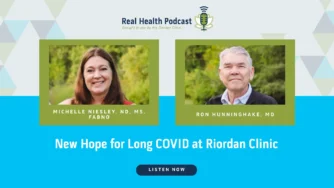
In this episode of the Real Health Podcast, Dr. Ron Hunninghake sits down with Dr. Michelle Niesley to discuss leadership at Riordan Clinic and what it means to move toward a more proactive approach to care.
They talk about how communication across teams shapes the experience for co-learners, and why that matters from the very first call through long-term follow-up. Dr. Niesley also shares her background in integrative oncology and research, and how that perspective helps her see where care can be more connected and more clear.
They explore what it looks like to move from a reactive model to a more proactive one—using testing, data, and patterns over time to better understand what each person may need. There’s also a conversation around newer tools, like wearable technology, and how those can help people stay more aware of what’s changing in their bodies day to day.
You’ll also hear how the co-learner model shows up in real life. People are asking more questions, looking for clarity, and wanting to be part of the process.
As Riordan Clinic looks ahead, the focus is on staying connected to the community, continuing research, and building on what’s already working to support co-learners over time.
Pearls & Purpose Gala
✨ Riordan Clinic is also celebrating 50 years of care at the upcoming Pearls & Purpose Gala. It’s a chance to come together, reflect on where the clinic has been, and support where it’s going. To learn more or reserve your seat, visit https://gala.riordanclinic.org/
Links and resources
Explore integrative services at Riordan Clinic: https://riordanclinic.org
Become a new co-learner: https://riordanclinic.org/become-a-patient/
Learn more about Dr. Ron Hunninghake: https://riordanclinic.org/staff/ron-hunninghake-md/
Learn more about Dr. Michelle Niesley: https://riordanclinic.org/staff/michelle-niesley-nd-ms-fabno/
Reserve your seat at the Pearls & Purpose Gala: https://gala.riordanclinic.org/
Watch more Real Health Podcast episodes: https://realhealthpodcast.org
Disclaimer: The information contained on the Real Health Podcast and the resources mentioned are for educational purposes only. They’re not intended as and shall not be understood or construed as medical or health advice. The information contained on this podcast is not a substitute for medical or health advice from a professional who is aware of the facts and circumstances of your individual situation. Information provided by hosts and guests on the Real Health Podcast or the use of any products or services mentioned does not create a practitioner-patient relationship between you and any persons affiliated with this podcast.
Read the Transcript
VIEW FULL TRANSCRIPT
Riordan Clinic [00:00:00]:
The information contained on the Real Health Podcast and the resources mentioned are for educational purposes only. They are not intended as, and shall not be understood or construed as, medical or health advice. The information contained on this podcast is not a substitute for medical or health advice from a professional who is aware of the facts and circumstances of your individual situation. Information provided by hosts and guests on the Real Health Podcast or the use of any products or services mentioned does not create a practitioner-patient relationship between you and any persons affiliated with this podcast. This is the Real Health Podcast brought to you by Riordan Clinic. Our mission is to bring you the latest information and top experts in functional and integrative medicine to help you make informed decisions on your path to real health.
Ron Hunninghake, MD [00:00:57]:
Hello everyone, I’m Dr. Ron Hunninghake and this is the Real Health Podcast. And today we’re talking about leadership at the Riordan Clinic. And I have with me as my guest, Dr. Michelle Niesley.
Riordan Clinic [00:01:10]:
Yes.
Ron Hunninghake, MD [00:01:11]:
Who is our CEO. CEO and has been our CEO now for about 9 months. About 9 months. And we did have an interview on this earlier, but. We did. A lot of water under the bridge.
Michelle Niesley, ND, MS, FABNO [00:01:22]:
Yes.
Ron Hunninghake, MD [00:01:23]:
So I am not forfeiting my leadership. I’m actually now the President of the organization and the Chairman of the Board. We also have Dr. Drew Rose, who is our CMO.
Michelle Niesley, ND, MS, FABNO [00:01:37]:
Correct.
Ron Hunninghake, MD [00:01:37]:
Chief Medical Officer.
Michelle Niesley, ND, MS, FABNO [00:01:38]:
Yes.
Ron Hunninghake, MD [00:01:39]:
So we’re doing some things with leadership here at the Riordan Clinic.
Michelle Niesley, ND, MS, FABNO [00:01:42]:
We are.
Ron Hunninghake, MD [00:01:43]:
Yeah.
Michelle Niesley, ND, MS, FABNO [00:01:43]:
Yeah.
Ron Hunninghake, MD [00:01:44]:
So Riordan Clinic has been a leader in the field of integrative medicine, functional medicine, Center for the Improvement of Human Functioning. Dr. Hugh Riordan, has been a huge force, uh, along with many, many other people who have developed this whole field. But now we’re moving more into an integrative space, so we want to kind of discuss all that. And so maybe tell me a little bit about your background and how you even came to be here, right?
Michelle Niesley, ND, MS, FABNO [00:02:16]:
Uh, so I’m a naturopathic doctor who has been in practice this year 25 years. Um, so I practice integrative oncology, so I’m a fellow of the American Board of Naturopathic Oncology and, uh, decided after I completed my integrative oncology residency that I needed a little bit more debt. So went to Dartmouth and got a master’s in evaluative clinical sciences, which was essentially a biostatistics degree. So I run clinical trials units. I had my own clinic in Eugene, Oregon with actually Dr. Stacy Dunn, who is also on our, on our staff, and, uh, was able to come aboard almost about 2 years ago now as the Direct part-time Director of Research. And the thing that really attracted me to the clinic at that time was, I mean, Riordan is famous for IV vitamin C. Anyone, any naturopathic doctor knows the name Riordan Clinic. I think internationally it’s really known to have set the standards and done a lot of the research when it comes to high-dose IV vitamin C and other intravenous therapies, right? So it was a really wonderful opportunity for me to be able to join a team who really was doing integrative medicine before integrative medicine was even a thing, right?
Ron Hunninghake, MD [00:03:32]:
Yeah, yeah. And so, and, and as part of your, your getting aboard and learning about how what goes on at the Riordan Clinic and working on some preliminary research, we had some changes in, in our CEO. Yeah. And we actually went through a couple CEOs and You were available. And I thought, you know, Dr. Riordan, the first leader of, of the Riordan Clinic, he was a physician also. And I got to thinking, what a neat idea to have a naturopathic doctor who has cancer training, who has had a lot of leadership experience. What about Dr. Michelle becoming our new CEO? And I put that in your lap, right? And it was a big ask, kind of, I bet, a bit scary, but it probably was a great opportunity. And I’m going to say you have done a fabulous job. But tell us about your side of it in terms of what was that like to have this kind of drop in your lap?
Michelle Niesley, ND, MS, FABNO [00:04:36]:
Well, I remember you calling me on a Friday afternoon and letting me know that this position had become available and that you had spoken with the board and that you wanted to offer it to me. So I— it was not on my bingo card for last year, right? It’s an opportunity that I didn’t honestly really ever think that I would have a chance to be the CEO of Riordan. So it was an opportunity that I jumped at, obviously. So, yes, a little bit of fear, a little— I mean, because of the international reputation, I take this job very seriously. And I really— we are celebrating, as you know, our 50th anniversary. You know, last year was 50 years. We have our 50th anniversary gala coming up and I really want to see Riordan do well for the next 50 years as well.
Ron Hunninghake, MD [00:05:25]:
So also, there’s, there’s a definite foundation. I’m just going to call it a feminine foundation in the Riordan Clinic. Mrs. Olive W. Garvey was really our patron saint. She had a very powerful vision for functional medicine even before that word came about. As a matter of fact, the center was called the Olive W. Garvey Center for the Improvement of Human Functioning International.
Michelle Niesley, ND, MS, FABNO [00:05:52]:
Yeah.
Ron Hunninghake, MD [00:05:53]:
And Dr. Riordan basically he ran it, but Mrs. Garvey was in many ways not only financially very supportive, but she had the instinct to understand that this was a direction that medicine needed to take. There was a kind of, and I’m going to call it a, you know, a healing feminine influence. And so really, I really feel like that’s come full circle now to have our CEO be a, female doctor. Yeah. With a tremendous amount of not only scientific experience, but leadership experience and an enthusiasm for what the future could hold for the Riordan Clinic. Am I—
Michelle Niesley, ND, MS, FABNO [00:06:36]:
Yeah. I mean, Olive Garvey obviously set us on the path. Her— that collaboration between her and Dr. Riordan was essential for us to even remotely become what we are right now, right? Yeah, I think from, you know, you and I had spoken about the fact that I don’t believe there’s been a physician CEO since Dr. Riordan, correct? No pressure. So, you know, I think one of the— I think I take a little bit different approach as someone who has— I don’t want to say just strict business training, not saying anything negative about anyone who has come before me. You know, that leadership, we’ve talked about this, it always builds on top of what has come before. But having, coming at it from, I’m a physician first.
Ron Hunninghake, MD [00:07:21]:
Right.
Michelle Niesley, ND, MS, FABNO [00:07:22]:
And so coming at it from that point of view, I think that I see things just a little bit differently. And I also know in my own practice and along with Dr. Dunn where some of the gaps were. And so being able to identify some of those opportunities that we can fill moving forward, really some other lines of service that we can explore that I think would be really fit right in line with the Riordan approach.
Ron Hunninghake, MD [00:07:44]:
Well, and also, and I’ve hit this, we had a conference here just late last year. It went very, very well. You and I actually presented on the two brains, the left brain, which is more statistical numbers, that type of thing. The right brain’s a little bit more whole vision type of thing. And then there’s that corpus callosum.
Michelle Niesley, ND, MS, FABNO [00:08:09]:
Yeah.
Ron Hunninghake, MD [00:08:09]:
The corpus callosum is the part that connects the two brains. And There’s actual research that women have a larger corpus callosum than men. And so this ability to integrate between these two perspectives, the, the objective and the subjective and the, the detail and the big picture. And I think, I think you have that and you bring that to this job. And I think going forward in the world we’re living in with AI and all kinds of changes in all the the health crises that’s going on around the world. We need to be able to integrate all of this in if we’re going to find solutions to some of the horrible problems that we’re facing these days.
Michelle Niesley, ND, MS, FABNO [00:08:53]:
Yeah, I agree. And it’s not without its, you know, there’s pitfalls. I mean, my tenure hasn’t been perfect. I don’t think anybody’s is. But I think it’s been a wonderful learning experience for us as a team. And speaking of team, I think that’s something that we spoke about this morning as well, is that One of the tenets that I’ve always had in any kind of leadership position is how do I empower my leaders so that they can manage their team, so to speak, even more effectively? And how do we also increase communication amongst team members? So I’m really not someone who tries to lead by top down. I’ll absolutely bring ideas to the table and put it out there to the group. But what I have really been impressed with actually is the different members of the leadership team I feel have really rose to the occasion and the communication is even better. We’re functioning like a cohesive team now.
Ron Hunninghake, MD [00:09:47]:
The leaders for the different parts, like our laboratory and the nursing staff and the medical assistants and the front desk, all of these were leaders, but they were kind of isolated in their own way. And now, as of the last maybe 2 months or 3 months or so, we see the leadership team taking on a kind of identity that they didn’t have before. So that we have leadership moving up and down. Yeah. There’s a communication link that was not quite there that I think you’ve helped to bring about.
Michelle Niesley, ND, MS, FABNO [00:10:26]:
Thank you. Yeah, I think it was needed, and I think it’s needed in any institution. And I think whenever there is a change kind of in structure, especially at the top, you know, the staff isn’t exactly sure what to expect. And so I’m hoping that, you know, I pride myself on being a connector of people, and that, That is one of the things, the goals that I definitely think of.
Ron Hunninghake, MD [00:10:49]:
We were a bit siloed. That’s a term that I’ve heard in the past, and now I feel like those have, uh, those— we now have this integration, integrative medicine, integrative, uh, leadership.
Michelle Niesley, ND, MS, FABNO [00:11:02]:
But it almost— I think about the body and think about usually from a, from a conventional medicine perspective, you have the cardiologist to look at the heart, and you have the pulmonologist to look at the lungs, and the nephrologist and the oncology— well, oncologist is obviously disease-specific, but like, you know, the nephrologist looks at the kidneys. And so they’re looking at their specialties, but really the body functions as one organ, uh, or one— not one organ, one system. And so really, that’s— I felt like with those silos, that same thing was happening, is that we were having those, you know, groups that maybe the communication wasn’t quite as good, or understandably they were looking out for what their team needed without necessarily understanding the ramifications for other team members. And I feel like now, you know, those leaders are out of those silos, and we have a much better understanding of what we need as a whole system as a whole body compared to, you know, just being the different separate parts.
Riordan Clinic [00:11:56]:
Are you looking for a delicious way to boost your immune system? Meet Sufficient-C, the crave-worthy immune support drink that makes staying healthy a treat, not a chore. Packed with 4,000 milligrams of non-GMO vitamin C, Sufficient-C is more than just a drink. It’s a powerhouse of immune-boosting goodness. With added L-lysine, bromelain, and 96% pure caffeine-free green tea extract, every sip is a step towards better health. And the best part? It tastes amazing. Our Lemon Peach Immune Aid mix is sweetened with pure stevia—no sugar, no guilt. Plus, it’s plant-based, gluten-free, kosher, and completely caffeine-free. So why settle for boring when you can have a flavorful, immune-boosting refreshment. Visit sufficientc.com and mix up your health routine with Sufficient-C, because your health deserves a delicious boost.
Ron Hunninghake, MD [00:12:54]:
Where do you see us going? We’ve, we’ve, we’ve, we’ve come a ways here in these last 9 months. We’ve got— we made it through our, our conference. We have a big gala coming up which is going to reflect on the last 50 years, right? But now we’re moving forward into the next 50 years and we have a number of fresh new ideas. We’re looking at some new therapies. We are. Certainly we’re going to continue to build on our foundation of integrative oncology. Where do you see us going?
Michelle Niesley, ND, MS, FABNO [00:13:28]:
Oh, good question. So I see us— so when I initially took this position, actually it was a little bit before, I remember sitting with leadership And one of the things that we want to do, we have very, we’re very well known internationally and nationally, but I think that there is going to be some forward progress made with establishing, reestablishing our roots here in Wichita and also Overland Park and making sure that we have connections with local universities, local physicians as a referral source, and just really reinvesting in the community again. That is one direction we are definitely going. We’re having some staffing changes to make sure that we can accommodate that as well. New therapies, as you said, we are always on the lookout for new therapies, new research, things come our way all the time. So we’re always, you know, investigating whether or not that would be a good fit for the Riordan Clinic. And then doing whatever we can from the backend, so to speak, from the provider end of what can we do to make sure that our co-learners are being well taken care of throughout the entire process. So from initial contact to initial visit to follow-up, follow-up visit and 5 years down the road, making sure that their communication with us, that they’re feeling heard, that they are getting their needs met in a way that is actually proactive. That is one of the things I think you and I have talked about before too, is that in this ever-changing world, a lot of places are very reactive and just trying to keep up. So we are trying to get from a reactive mode to a proactive mode. And so we’re looking at that also from a Co-Learner Care perspective. Yeah.
Ron Hunninghake, MD [00:15:10]:
The term survivorship, we’re using that a lot more because we, we do work a lot with cancer patients, and we are— our goal is for them to become long-term survivors. But no, we’ve got long COVID patients now that are dealing with a horrible disease that need long-term follow-up. I’m excited about the prospect of, uh, you know, everyone’s— I have a lot of people that are afraid of AI. I’m actually thinking maybe this, you know, because people have all these wearables and they’re getting— there’s a lot of testing that people can do on their own at home, as well as the laboratory testing that we do here, as well as new knowledge. Can we fit that into some kind of program where people can be followed not only by the doctor, but also through this new AI technology that they can wear, that they can have in their phone? And that, so it’s not just the doctor’s visit anymore. It’s going to be a whole lineage of things that we can do to help people stay in the groove and to map their progress back to super health.
Michelle Niesley, ND, MS, FABNO [00:16:18]:
Right. And accountability is huge. And so being able to see how going to bed an hour later impacts your sleep, right, or eating too close to dinner impacts or before bed impacts your sleep, looking at being able for each person to kind of identify some of those issues, I think is— I think you’re right on about that.
Ron Hunninghake, MD [00:16:38]:
Yeah. Well, I, I, I’m, I’m hoping that your science background your research background will also— we want to start publishing again more because we— there for a while we were publishing a lot and that kind of tapered off. But I think what we’re looking at is a different realm of data. It’s not the same thing where it’s an isolated experiment on one therapy. It’s like, how does this orchestrate? Sure. How does this fit together?
Michelle Niesley, ND, MS, FABNO [00:17:07]:
Well, and that is always the challenge with integrative medicine research, for example. So no one ever comes to the clinic and all we do is say, you’re going to get IV vitamin C and that’s it. We’re always doing nutrient testing. You know, I was talking with Dr. Stacy Dunn this morning about integrative oncology. And, you know, you can have two patients with the same diagnosis who receive the same conventional treatment, and yet you do the nutrient testing, you do the terrain testing. We’re looking at mycotoxins and environmental toxins and all sorts of other things. And you may find, too, even though on the surface they are very similar patients, they may end up getting very different treatment plans from us because of what we find based on that testing.
Ron Hunninghake, MD [00:17:49]:
So epigenetics, epigenetics, because it’s not just the genes that you, you were born with, but how have you made choices that have expressed certain genetic factors? And, and we know a lot more about that than we did in the past. How can we incorporate that into the long-term care process that co-learners are wanting to have.
Michelle Niesley, ND, MS, FABNO [00:18:12]:
And I think bringing that back, it does, data matters, right? And so the more data we can collect and see how someone’s heart rate variability reacts after an IV or something, all of that is putting pieces of the puzzle together. And I think the more data we have, the better we are going to be able to make more evidence-based recommendations to our co-learners.
Ron Hunninghake, MD [00:18:33]:
Yeah, yeah, that simple word, co-learners. That was Dr. Riordan’s, I think, brave new insight into the world that we’re coming into now, is that people are no longer going to be passive recipients of medical care. Sure. People want to be part of the process. And the Riordan Clinic is a pioneer in that area. We just need to learn to do it better.
Michelle Niesley, ND, MS, FABNO [00:18:57]:
Right. Well, and I mean, we’re always going to be improving. I mean, I think you and I had talked like you’re still learning, right? Yes. And I’m still learning. We’re all still learning. There’s always new information coming out. So yeah, co-learner. I, when I was working with my own patients in private practice, you know, one of the things that I would say is this isn’t a monologue, it’s a dialogue, right? So we need to have the back and forth and you need to tell me when certain things are working and when they’re not. And when I can understand their story better, I can make better recommendations for them specifically. And so I think the term co-learner just solidifies what we do here.
Ron Hunninghake, MD [00:19:32]:
Yeah. I’m very interested now that I’m gonna be turning 75 next month is the whole senior area is ripe. I mean, I think seniors are getting involved in this pretty heavily and they’re realizing they’re not gonna just grow old. They’re going to grow wiser. They’re going to learn how to use some of this technology themselves. They’re very interested in nutrition, health, and, fitness, they want to do it. They’re not, they’re not passive anymore.
Michelle Niesley, ND, MS, FABNO [00:20:03]:
They are not. They are not. And definitely a growing population that is embracing AI and embracing wearable technology and other things as well. The thing I think also that’s interesting is that we’ve seen, you know, with the advent of in the past 20 years or so, you know, I used to have people bring a bag of supplements that maybe they researched on the internet, but now there’s so many, there’s influencers and there’s, health coaches, and there’s some people that are giving some great information and maybe some not so great information. And I think that that is also something that sets us apart, is that by testing those nutrient levels, by testing the co-learner that is in front of us, we’re able to pinpoint that their specific plan, um, which may be different, like I said, from somebody else with a very similar diagnosis, you know, treating the co-learner as the individual. And again, those wearables or AI technology, I think, is going to be something that will help us tailor those plans.
Ron Hunninghake, MD [00:20:59]:
Yeah, my goal is always to empower the co-learner. I’m just going to say patient. But, you know, patients are no longer patients. They’re impatient. They are, as they should be. Yeah. And so, but how do we get people involved in a way that they feel comfortable? And because they’re, you know, all this stuff oftentimes overwhelms me.
Michelle Niesley, ND, MS, FABNO [00:21:20]:
I was just going to ask that question.
Ron Hunninghake, MD [00:21:22]:
And so, so I definitely have that sense of, of allegiance to my older patients. And I’m excited that they have the enthusiasm that they do that, you know, we can make a difference in our aging process. We are not victims of the growing old thing. Because I think it’s a whole different ballgame now.
Michelle Niesley, ND, MS, FABNO [00:21:45]:
It is. And I think, again, to talk about testing, I think just because someone has more experience in this world, as you know, maybe a little bit older, doesn’t mean that getting those nutrient levels and doing the testing, it can be beneficial at any age, like really any age. And I think the other thing, sorry, being able to provide co-learners with a very good roadmap of where to go because you just, you know, the feeling overwhelmed. I’m in my 50s and I feel overwhelmed at times by everything that is available and out there and all the different streams of social media I could be consuming and everything else. And so I think one of the things that we’re really working on is having a very tailored approach to make sure there’s a clear roadmap and kind of taking away some of that noise that I feel all of us are dealing with on a daily basis.
Ron Hunninghake, MD [00:22:34]:
Yeah. I, the way I see it is that we’re not dealing with people who are afraid of dementia or afraid of cancer or afraid of heart disease. These are people who say, well, I have that in my family history. I have some symptoms. What can I do now to, to turn this around? Sure. And to, and actually, actually make it a kind of a catapult into a better overall lifestyle of, of, uh, efficient living. Sure. Dr.
Michelle Niesley, ND, MS, FABNO [00:23:03]:
Dunn and I were actually speaking about this, that this morning, from an integrative oncology perspective, how often we’ll have co-learners present in our private practice before our patients present, and then they would feel worse during chemo and everything, but then after chemotherapy and treatment ended, they actually were feeling better than their baseline, right? And so I think that that really is the goal of maybe there is this predisposition or maybe they have an early diagnosis of diabetes or something, but how can we get them, you know, not only maintain their health and make sure that that doesn’t decline, but how can we actually get them to a better place?
Ron Hunninghake, MD [00:23:40]:
Yeah, family history is not destiny. No. So epigenetics is telling us that. And now we just need to live it in this, in this evolving clinical environment of of better health and better living. So we, I, we, our staff are very excited that you’re with us. And I know it’s a challenge, but hey, that’s what life’s all about.
Michelle Niesley, ND, MS, FABNO [00:24:05]:
It is. And I think we are very thrilled with the recent changes as well, you know, with our Dr. Drew Rose moving to DCMO and then you being at the top of that pyramid as the president and the chairman of the board. But I’m kind of stepping back too.
Ron Hunninghake, MD [00:24:18]:
I’m going to let you kids play. And make it work. I’m in my 50s. But for me, you’re a kid. Right. Yeah. A good kid. A wonderful adult kid.
Michelle Niesley, ND, MS, FABNO [00:24:29]:
Most of the time. Yes. Most of the time.
Ron Hunninghake, MD [00:24:31]:
Yeah. Little ornery, but that’s good too. That’s fair. My dad said a little bit of orneryness, that’s what you want. You want that. Absolutely. Yeah. So thanks, Michelle. Yeah. Thank you.
Michelle Niesley, ND, MS, FABNO [00:24:40]:
I’m excited about the future. I am too. This third generation, I think we’ve got a lot of potential.
Ron Hunninghake, MD [00:24:45]:
Yeah. Yeah. Thank you everyone for listening.
Riordan Clinic [00:24:50]:
Thank you for listening to the Real Health Podcast. If you enjoy this episode, be sure to subscribe and leave us a review. You can also find all of the episodes and show notes over at realhealthpodcast.org. Also, be sure to visit riordanclinic.org where you will find hundreds of videos and articles to help you create your own version of real health.