
“Toxins are everywhere — in our food, water, and air. They damage our mitochondria, disrupt metabolism, and open the door to disease.” —Dr. Richard Cheng
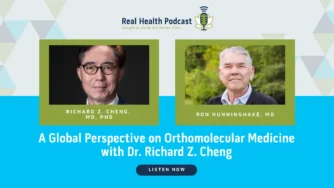
In this episode of the Real Health Podcast, Ron Hunninghake, MD, sits down with Richard Cheng, MD, PhD, ABAARM — physician, researcher, and editor of Orthomolecular Medicine News Service — to explore how environmental toxins and mitochondrial dysfunction are driving today’s rise in chronic illness and cancer.
Dr. Cheng shares how decades of research have revealed the link between toxins, aging, and cancer and why supporting mitochondrial health and reducing environmental exposure may be one of the most effective preventive strategies in modern medicine.
👉 This conversation is part of the Cancer Care Reimagined Speaker Series, leading up to Riordan Clinic’s Cancer Care Reimagined Conference this November.
You’ll hear:
→ Why environmental toxins are the top global health threat
→ How mitochondrial dysfunction connects aging, cancer, and chronic disease
→ The overlooked role of heavy metals, seed oils, and ultra-processed foods
→ Practical ways to reduce exposure and support detoxification
→ How vitamin C protects against oxidative damage and supports cell repair
Meet Richard Cheng, MD, PhD, ABAARM
Dr. Richard Cheng is a physician, researcher, and expert in anti-aging and integrative oncology. He trained in internal medicine in Shanghai before earning his PhD in biochemistry and molecular biology from the University of Arkansas for Medical Sciences. He later completed fellowships at the National Cancer Institute (NIH) and the American Academy of Anti-Aging Medicine (A4M). As editor of the Orthomolecular Medicine News Service, Dr. Cheng advances education and research around nutrient-based and metabolic therapies for cancer prevention and treatment.
Thanks to This Series’ Sponsor
This series is made possible by Empower, the Platinum Sponsor of Cancer Care Reimagined Conference. As a national leader in compounding pharmacy and 503B outsourcing, Empower serves providers and patients across all 50 states with safe, affordable, and personalized medications. Guided by the belief that behind every order is a person in need, they bring compassion and innovation to everything they do. Learn more at empowerpharmacy.com.
Links
▶️ Watch this episode on YouTube: https://www.youtube.com/watch?v=3pdVwGCimQ0
🎟️ Register for the Cancer Care Reimagined Conference: https://cancercarereimagined.org
💊 Learn more about Empower Pharmacy: https://empowerpharmacy.com
🔗 Explore the Riordan Clinic: https://riordanclinic.org
🎧 Listen to more episodes of the Real Health Podcast: https://realhealthpodcast.org
Disclaimer: The information contained on the Real Health Podcast and the resources mentioned are for educational purposes only. They’re not intended as and shall not be understood or construed as medical or health advice. The information contained on this podcast is not a substitute for medical or health advice from a professional who is aware of the facts and circumstances of your individual situation. Information provided by hosts and guests on the Real Health Podcast or the use of any products or services mentioned does not create a practitioner-patient relationship between you and any persons affiliated with this podcast.
Read the Transcript
VIEW FULL TRANSCRIPT
Riordan Clinic [00:00:00]:
Hello and welcome to the Real Health Podcast. Today’s episode might sound a little bit different because I want to tell you about our Cancer Care Reimagined Speaker Series. When we began planning our 25th International Conference on Human Functioning, Dr. Ron Hunninghake sat down and created his dream team of speakers. Now we reached out to all of them and we were so delighted that they all said yes. These speakers are leaders in integrative oncology, functional medicine and research who are truly shaping the future of cancer care. Each week leading up to the conference, we’ll feature one of these extraordinary experts right here on the Real Health podcast. They will be sharing insights, innovation and inspiration to help you reimagine what’s possible in cancer care. Now this series and the upcoming conference in Gala would not be possible without the generous support of our presenting partner, Empower. Did you know that Empower is the most advanced compounding and 503B outsourcing facility in the nation? They are licensed to serve in all 50 states and they are deeply committed to improving access to safe, affordable and personalized medication for the patients, providers and caregivers who rely on them. Their belief is simple but powerful. Behind every order is a person in need and with that knowledge, they approach everything they do with compassion, innovation and a drive for excellence. We are so grateful for their partnership and their support of this important conversation around Reimagining Cancer Care now. If you’re looking for tickets, they are on sale now and you can go to our website@Cancercarereimagined.org you can also find tickets for our 50th anniversary gala@CancercareReimagined.org gala now these links will be posted in the show notes below. We hope that you will join us here in Wichita this November for both unforgettable events.
Ron Hunninghake, MD [00:01:44]:
Well, welcome everyone. I’m Dr. Ron Hunninghake here at the Riordan Clinic. This is the Real Health Podcast and we’re getting ready to have the 25th International Conference on Human Functioning. Dr. Hugh Riordan was a pioneer in the field of integrative medicine, orthomolecular medicine, and our conference is focused on Cancer Care Reimagined. We’re taking another look at are we really getting down to the root causes of what’s causing cancer and do we really need to take a more integrative approach in terms of helping our patients find their way to the right kinds of treatments in order to have better results from their long-term cancer care? And so to that end, I’m so pleased to introduce Dr. Richard Cheng, who will be one of our speakers. Dr. Cheng. May I call you Richard?
Richard Cheng, MD, PhD, ABAARM [00:02:38]:
Yes, please.
Ron Hunninghake, MD [00:02:39]:
Yeah, Richard, I’m. Yes, please. So I am so thrilled. You know, we go way, not way back, but pretty far back. Because you are the editor. Editor of orthomolecular.org. there’s a news service there that I think everyone should know about. But tell me before we get to that, tell me a little bit about your background in the field of cancer care. What is your specialty and how does that relate?
Richard Cheng, MD, PhD, ABAARM [00:03:03]:
Yeah, all right. Yeah. First I trained as an internist back in Shanghai. And then 40 years ago. Exactly. I went to actually Arkansas University of Arkansas for medical Sciences at Little Rock where I did my PhD in biochemistry and molecular biology and I did actually cancer genetics. Then I went into the medicine and laboratory medicine training. After that I went to NCI NIH clinical fellowship on hematology, lymphoma, particularly on lymphoma study. And after that then I graduated, so to speak. Eventually I started my own practice and during this period of the last 20, 30 years, I picked up also molecular medicine. And also I got trained at the American Academy of A4M Medicine where I also got fellowship board certified at the anti-aging and also integrative cancer therapy. So cancer has been majority part of my career. Yeah.
Ron Hunninghake, MD [00:04:16]:
So you’re into anti-aging. But you know, our cancer patients, they desperately want to anti age, you know what I mean? They’ve got a horrible diagnosis that they’re fighting and they’re trying to look for what can I do to help me get over it. And maybe they’ve done the conventional side of it, but it doesn’t seem like it’s enough. So there’s a lot that the integrative approach brings. But your specialty and your kind of focus, that chiseled focus that I think is really incredible, is that you’ve made a discovery that environmental toxins may be an under, shall we say, an underdiagnosed cause of the progression of cancer. So how does that all work?
Richard Cheng, MD, PhD, ABAARM [00:05:03]:
Actually, that’s very, very. You know, you hit the nail on the head right there. First of all, cancer and aging, very interesting. Back in the graduate school days, that’s like 30, 40 years ago. So basically we were looking at cancer and aging kind of like the two sides of the same coin. See what I mean? Yeah. You know what I mean? So at that time we were studying the mechanism of senescence, so to speak. Cellular senescence, aging, cellular aging as a way of a cancer mechanism. But coming back to today. So for a long time you know, we were focused on genetic mutations and everything. And over maybe about 15, it’s about 15, 20 years ago when I started, when I started getting older and I started looking to anti-aging myself. So mitochondria became a focus. You know, it’s the powerhouse. So I’ve known about the importance of mitochondria for a long time. So this question was in my mind a long time ago. Well, you know, mutagens or carcinogens, lots of them are there, right? Well characterized. Well, you know, no controversy there. Everybody agrees these, you know, cigarette smoking, heavy metals, these are carcinogens.
Ron Hunninghake, MD [00:06:23]:
Glyphosate. Yeah, all that stuff.
Richard Cheng, MD, PhD, ABAARM [00:06:25]:
Tons of them. Tons of them, right. So I asked that question a long time ago. I never really looked into. So basically the question was if these carcinogens cause mutations, which we know, do they also cause damages to other cellular structures, for example, mitochondria? And also if they. We know, we know. The more we know about mitochondria, the more we know how important is. Actually I really look into it. So far I have not found any disease, mostly chronic, that if it’s been studied, that doesn’t have a mitochondrial dysfunction component. Meaning mitochondrial dysfunction so far is observed in practically every major chronic disease. So I ask the question, if these carcinogens can cause genetic mutations, contribute to cancer, do they also cause mitochondrial dysfunction and do they also contribute to ascvd, which is coronary artery disease or stroke, as well as diabetes and other diseases too? I didn’t have time to look at everywhere. Sure enough, actually I picked out a few major carcinogens for each of the categories. There are so many categories. And I did a deep search and sure enough I found that practically all of those carcinogens can at the same time cause genetic mutations. And as well as mitochondrial dysfunction, they also have been closely correlated to at least coronary artery heart disease, stroke, as well as type 2 diabetes. And there are few anti-aging as well. So sure enough, basically the point here is that toxins are very, I mean they’re not that specific. When they come into your cell, into your body, they wreak havoc, they damage everything on the way. And primarily mitochondrial dysfunction as well as genetic mutations.
Ron Hunninghake, MD [00:08:29]:
Yeah.
Richard Cheng, MD, PhD, ABAARM [00:08:29]:
So yeah.
Ron Hunninghake, MD [00:08:31]:
So anyone who’s got cancer, not anyone and everyone, but most people will get a PET scan. And people have, you know, that’s one of the first things I’ll ask a cancer patient, have you had a PET scan? And they say yes. And they know that if it lights up that that’s where the cancer is. And so That’s a lot of people have said that is the essence of cancer, where the normal mitochondrial function, instead of doing its 32, 34 ATPs per molecule of glucose, it shifts to glycolysis. It’s a backup energy production system in the body. It’s. And so when the cancer cell and why it does this, no one can really explain why would the cell want to shift to this backup system. So one of the explanations could be when it’s toxic, the, the, and the mitochondria are working, the cells have to back up to the glycolytic pathway in order to generate enough energy to stay alive. So that’s, that’s one explanation for this. So also infections and, and one of the things that I talked about in Japan was fungal infections also can induce this. But again, when the cell becomes weak, when the energy levels become low, that’s where the dysfunction occurs and that’s where it tends to move into a cancerous state.
Richard Cheng, MD, PhD, ABAARM [00:09:56]:
Absolutely. That’s actually a very interesting point. As I presented recently in a cancer debate at the Children’s Health Defense, this is one of the ironies in modern cancer. You know, for example, PET scan you mentioned, it’s been well established in conventional medicine, modern day medicine for over 20 years as diagnostic tool. The theory right there behind it was well accepted because cancer cells pick up more, they require more glucose. So that’s the foundation. However, the same theory that’s well accepted by the conventional medicine for diagnosis, it’s been totally ignored in treatment, if you believe. Right, because we believe cancer cells pick up more glucose from the environment than the neighboring cells. That’s why they, cancer cells light up. Glycolysis, however, we don’t apply it in clinical treatment. What’s the problem? Why, why do we suddenly conveniently forget about this Warburg Effect in treatment?
Ron Hunninghake, MD [00:11:00]:
Right, Warburg. Yeah, no, I know. And interestingly enough, where it just reigns supreme here at the Riordan Clinic, our whole focus, Dr. Riordan, was paramount in the discovery of using high-dose vitamin C as a treatment, as part of a treatment for cancer patients. And the mechanism of how that works. The cancer cells, because they’ve shifted to glucose to the glycolytic pathway, they were there. They will increase their numbers of glucose transporters by 40, 50 fold. And because the vitamin C molecule is so similar to glucose, they’ll suck in a lot more vitamin C. And if you get enough vitamin C in the cells, it will, the cancer cells contain excess iron. It will start to reduce the iron to a more active state and the reduced Iron will will then interact with the cell and create hydrogen peroxide. And if you get enough vitamin C, the buildup of hydrogen peroxide will kill the cell. So that’s a, that’s, that’s how we got to, to know about vitamin C. But vitamin C, that’s not the only thing. Vitamin C can act as a detoxifier, it can act as a metabolic stimulant, it can reduce pain. There’s a number of things it can do. But it comes back to the fact that these cells are damaged and what is causing the damage. And this is where you’re saying we’ve ignored the fact that our modern environmental realm is so cluttered with toxins that the poor cells, the poor mitochondria, are unable to maintain their normal functioning and then they regress back to this oncogenic state of functioning.
Richard Cheng, MD, PhD, ABAARM [00:12:48]:
Absolutely. There are two points I want to mention before I forget. One is we talk about toxins. There’s a recent study that showing globally toxin or environmental toxin, all these things together, they are the number one global killer more than anything else. Toxin, how important that is. Number two, very interesting. I mean a satellite is that over the past 30 years, the early onset cancer, basically young people younger than 50 years of age, people suffering from cancer increased by 80%.
Ron Hunninghake, MD [00:13:26]:
Oh my gosh, yes.
Richard Cheng, MD, PhD, ABAARM [00:13:27]:
Just within the last 30 years. You can’t simply explain that by the genetic mutations and the same group of Those younger than 50 years of people, the death rate increased about 28%. We talk about war on cancer, it’s a total failure.
Ron Hunninghake, MD [00:13:46]:
Yeah, well, let’s kind of, for the sake of our audience, their awareness of toxins, let’s just kind of go through a little bit of a list of what are some of the more important toxins that people can make decisions on their own to help them avoid the, the toxin exposure. So in your, in your thinking or in your research, kind of, let’s just start. What are some of the things you think about in terms of helping our audience be aware of and avoid the critical toxins?
Richard Cheng, MD, PhD, ABAARM [00:14:18]:
Yeah, actually. So basically let back up a little bit in a recent paper that I summarized, I already submitted, it’s online available right now. It’s not peer reviewed, it’s not being officially published yet, but it’s available public to open to public. So I look at all the so called root drivers. Basically root drivers are these factors that everyday life that we encounter. These may not necessarily be the causative factor that make you to have cancer right away, however they contribute. So that’s why we Call them root drivers. Not necessarily directly leading to cancer, but they contribute to. So basically there are 10 categories. The top one is the environmental toxin, like I just mentioned. Okay. Now during conference I’m going to talk about all of the 10. But in the toxin category, let’s expand a little bit more. So in the other than the environmental toxins that we already know, the PM2, 5, the cigarette smoking, all these things, heavy metal is a major one. Even in the United States. Heavy metal, unfortunately, most people, we don’t really realize unless we get tested, otherwise we don’t know how bad heavy metal can be. Well, these heavy metals, they are supposed to be underground, but these days, because of the digging, mining, all kinds of mining, then coal burning, they get into the air, getting to our life. That’s a major one also, you know, from seafood and everything everywhere else.
Ron Hunninghake, MD [00:16:01]:
Mercury, lead, cadmium, those types of things.
Richard Cheng, MD, PhD, ABAARM [00:16:04]:
Lead, yes. And even mercury, even in the United States.
Ron Hunninghake, MD [00:16:08]:
Dental fillings.
Richard Cheng, MD, PhD, ABAARM [00:16:10]:
Dental fillings, yes. You know, and the vaccines.
Ron Hunninghake, MD [00:16:13]:
You know, vaccines, yes, that whole story.
Richard Cheng, MD, PhD, ABAARM [00:16:16]:
Yeah, that’s another source. You know, so these are also another major one actually more probably so is the. Actually ultra-processed foods.
Ron Hunninghake, MD [00:16:26]:
Oh yeah. Oh, I think that’s a big one.
Richard Cheng, MD, PhD, ABAARM [00:16:28]:
Yeah, that’s a big one. So in my second paper that I already uploaded onto preprints, I also look into these various ultra-processed foods. Yes. They are also highly correlated to mitochondrial dysfunction, to metabolic, you know, metabolic abnormality.
Ron Hunninghake, MD [00:16:49]:
Contributing to all these obesity, diabetes and all that. All that.
Richard Cheng, MD, PhD, ABAARM [00:16:54]:
All these problems. Yeah, that’s a, I think that’s a major, big, big one. High carb, of course, you know, eating high sugar, particularly refined sugar, with these problems.
Ron Hunninghake, MD [00:17:05]:
Yeah, Seed oils, you know, that’s another part of that.
Richard Cheng, MD, PhD, ABAARM [00:17:08]:
That’s a major one actually. That’s part of the ultra-processed foods.
Ron Hunninghake, MD [00:17:12]:
Right?
Richard Cheng, MD, PhD, ABAARM [00:17:14]:
Ultra processed. These are not natural foods. Just think about it. You know, we talk about this, is that seed oils are agricultural products that didn’t exist before industry appeared.
Ron Hunninghake, MD [00:17:26]:
Right. And they’re all oxidized and the cells can’t use them very well and they just try to store them away, but they just cause oxidative stress, so.
Richard Cheng, MD, PhD, ABAARM [00:17:34]:
Yeah, exactly. They damage your particular mitochondria. Right, yeah, that’s a major one. So and you know, of course there are other categories of root causes. And in the root cause we apply this integrative orthomolecular medicine method that includes hormonal imbalance. For example, I think I learned a lot from you about thyroid hormone.
Ron Hunninghake, MD [00:18:01]:
Thyroid.
Richard Cheng, MD, PhD, ABAARM [00:18:02]:
A lot of people have this underactive thyroid or they May even have cellular level of thyroid, underactive thyroid. I learned a lot from you in that particular area, among other things.
Ron Hunninghake, MD [00:18:17]:
And I’m thinking of microplastics, too. The whole microplastic issue is turning out to be much bigger than what we thought, and it affects. Especially can affect the brain. And a lot of people are saying, I can’t remember anything anymore. Well, it may be part of this.
Richard Cheng, MD, PhD, ABAARM [00:18:35]:
Yeah, yeah, yeah, Absolutely right. You know, that’s one major concern here, is that because many of the other toxins, I think we already know, somehow to a certain degree, we can detox. Yeah. You know, heavy metal, we can chelate, and organic is the ones we can do by enhancing liver detox, you know, but plastics, we don’t know what to do.
Ron Hunninghake, MD [00:18:57]:
You have to just avoid them. Yeah, yeah, we have to avoid.
Richard Cheng, MD, PhD, ABAARM [00:19:01]:
The only thing I know of right now is I’ve learned that, you know, we all pay attention, is that by boiling water, I haven’t. You know, in China, they always boil water. And in the United States, I’ve been in the United States for 40 years, we don’t boil water. But then I begin to see studies showing up showing that if you boil water, actually you can, you know, sort of aggregate those plastic particles, they sort of deposit. You can remove a lot of those particles that say, oh, that makes sense. Because I used to think boiling water, you know, just killing the bacteria. I said, no, I don’t worry about that. You know, but now I do. I begin to boil water, let it settle so those particles may settle down, and then you drink that water. Well, I don’t know what else to do. That’s one thing that I feel I could do. Yeah, yeah, that’s a major one. Yes.
Ron Hunninghake, MD [00:19:53]:
Yeah, sure.
Richard Cheng, MD, PhD, ABAARM [00:19:54]:
And also avoid all the particles. You know, for example, I only advise. I don’t do it, you know, any organic solvent, any liquid, don’t store it with any sort of plastic container, plastic bottles. Yeah, literally. Acid, alcohol, all these things don’t store in plastics because, you know, they.
Ron Hunninghake, MD [00:20:12]:
The. The beverage cans are coated with a layer of plastic on the inside. So that’s.
Richard Cheng, MD, PhD, ABAARM [00:20:18]:
Yes, they’re just.
Ron Hunninghake, MD [00:20:18]:
It’s just everywhere.
Richard Cheng, MD, PhD, ABAARM [00:20:19]:
So remove that, reduce those. You know, what can we do? It’s a way. Living a very poisonous world. Toxic word.
Ron Hunninghake, MD [00:20:28]:
So, yeah, so, okay, so in terms of. You’re. So, I guess with toxins, the number one thing that we’re kind of encouraging our audience to think about is awareness. If you’re not aware of it, if you’re not making decisions, you’re going to be A victim of it. But is there anything, are there other strategies? And I, I always tell people vitamin C is a metal chelator. Vitamin C stimulates detoxification. So I think the IV vitamin C protocol that we put patients on, it’s, I think it works at many different levels. And vitamin C itself enhances the overall functioning of the, of the individual, the cell. Dr. Thomas Levy, our good friend, he will tell you that the most important molecule is vitamin C and getting the vitamin C into the cell.
Richard Cheng, MD, PhD, ABAARM [00:21:18]:
Absolutely. I learned so much from you guys, from Tom Levy on vitamin C and many others. I always say he’s one of you. The two of you are my best mentors in my entire competitive career. Seriously. Actually about that. There’s more about detox, the way, you know, simplest ways. First of all, be aware of it. Then try to avoid, like I just mentioned, you know, and if you can bring your own, like coffee mug with you instead of using these plastic lined paper ones, whatever, simple ones. And also drink a lot of water. Drink, you know, try to drink water rather than these beverages. And sweat, natural sweating. I love exercise. Yes, I tend to exercise three, four time. I even, you know, exercise every day. But unfortunately that’s too much. I hurt my wrist a little bit.
Ron Hunninghake, MD [00:22:10]:
Oh no.
Richard Cheng, MD, PhD, ABAARM [00:22:12]:
So you have to slow down. Don’t overdo it. And one thing about vitamin C you mentioned is that yes, vitamin C and other antioxidants are sort of key leaders. But don’t forget these toxins are practically oxidants.
Ron Hunninghake, MD [00:22:27]:
Right.
Richard Cheng, MD, PhD, ABAARM [00:22:28]:
You know, I discussed with Tom Levy extensively. Is that practically, you know, I can’t say probably all, but mostly most of these toxins are oxidants. They cause chemical bonds in our body. Those are oxidation, redox, redox reactions. So basically, if you enhance taking optimal ortho molecular dose of these antioxidants, you are protecting your normal structures against these toxins from being oxidized. So not only chelation, but also they can protect our cells. For example, we all know the first study we know of for high vitamin C for ASCVD was a 1956 study over that basically was 500 milligram vitamin C three times a day. This data was able to show that it works for certain about 10 of 16 patients. But today I don’t think that works anymore.
Ron Hunninghake, MD [00:23:39]:
Not enough. It’s not enough.
Richard Cheng, MD, PhD, ABAARM [00:23:41]:
Yeah, way, way too many toxins. Way too, you know, in our environment.
Ron Hunninghake, MD [00:23:45]:
Yeah, it comes back to orthomolecular medicine. The whole concept that Dr. Riordan, a number of doctors were promoting early in the 70s is that the world we live in requires higher amounts of nutrition than what we can get just from whole foods. And it’s harder and harder to get whole foods. So we need to be taking, about taking, thinking about supplement that we can take. That’s why we usually measure the levels of all of our new patients to find out where their deficits are and then try to fill those in. And more often than not, that’s something that will help them get over any number of diseases. But of course, cancer is one of the key ones these days. And so.
Richard Cheng, MD, PhD, ABAARM [00:24:25]:
Yeah. Yeah.
Ron Hunninghake, MD [00:24:26]:
Well, I’m thrilled, Richard, that you could be on our program. I’m wanting everyone to know that if they. And I want the audience to know that the, that this conference is open to the general public. This is actually the 25th international conference that’s being sponsored by the Riordan clinic. Yeah, we’re 50 years old now and Dr. Riordan was very much concerned about the average co learner. He didn’t even refer to them as a patient. He says, you know, we as physicians, doctors, nurses, healthcare, we are all in this together. We’re in just as much jeopardy as any patient. And so what we want everyone to know is that anyone can come to this conference. It’s going to be all about how we can use both sides of our brain, the left brain and the right brain, find the middle ground so that we’re not fighting one another. We’re looking for what’s going to work the best to help our cancer patients achieve the very best results. And for all of us to avoid cancer if possible, to get over it as quick as we can, but most importantly, to improve our overall quality of life and, and health and well being. So, Richard, thank you very much for all you’ve done. Once again, I want everyone to, if you think go to orthomolecular.org and then Richard has, has been the editor now of the new service there. Hundreds of fascinating, wonderfully written articles that you won’t see in just the, the general literature, but it’s a very great place to find out about not only orthomolecular medicine and cancer care, but how to optimize your overall health and wellbeing. And so, Richard, thank you for your contribution to all of this and we look forward to hearing from you at our conference. So thanks again.
Riordan Clinic [00:26:10]:
Thank you for listening to the Real Health podcast. This episode was brought to you by Empower Pharmacy, the most advanced compounding pharmacy and 503B outsourcing facility in the nation. Licensed in all 50 states and empower is committed to improving access to safe, affordable, and personalized medications for patients, providers and caregivers. Learn more at empowerpharmacy.com. If you enjoyed this episode, be sure to subscribe and leave us a review. You can also find all of the episode and show notes over at realhealthpodcast.org also be sure to visit riordanclinic.org where you will find hundreds of videos and articles to help you create your own version of Real Health.